If you have spent any time trying to rank a website, you already know that great content and clean code are only half the story. The other half happens away from your website entirely — and that is exactly what off-page SEO techniques are built to handle. While on-page SEO focuses on what you control directly, off-page SEO strategies focus on how the rest of the internet perceives, references, and trusts your site.
In this guide, we will break down every major category of off-page SEO techniques, explain why they matter, and show you exactly how to apply them without falling into outdated or risky tactics. Whether you are new to search marketing or refining an existing strategy, this guide will give you a practical roadmap for using off-page SEO techniques to grow organic visibility in 2026 and beyond.
What Are Off-Page SEO Techniques?
Off-page SEO techniques refer to all the actions taken outside your own website to improve its position in search engine results. Unlike on-page SEO, which deals with title tags, headings, internal structure, and content quality, off-page optimization efforts are about building trust signals from external sources — other websites, social platforms, review sites, and even offline mentions of your brand.
Search engines like Google cannot simply take a website’s word for it when it claims to be authoritative. Instead, they look at how other trustworthy sources talk about that site. This is where off-page SEO techniques come in: they are the mechanisms through which your website earns votes of confidence from the wider web. The more relevant, high-quality signals you accumulate, the more search engines trust your domain to answer user queries accurately.
Why Off-Page SEO Techniques Matter for Rankings
Search engines use hundreds of ranking factors, but authority and trust remain among the most heavily weighted. This is precisely why off-page SEO techniques carry so much influence over where your pages land in search results. A well-optimized page with zero external validation will almost always struggle to outrank a page with strong external endorsement, even if the on-page optimization is weaker.
Here are a few reasons off-site SEO methods matter so much:
- They build domain authority. Backlinks from reputable sites signal that your content is trustworthy and worth referencing.
- They increase referral traffic. Beyond rankings, this kind of work often brings direct visitors from the platforms where your brand is mentioned.
- They improve brand credibility. Consistent mentions across the web make your business look established and reliable to both users and algorithms.
- They support local visibility. For location-based businesses, citations and reviews — both forms of off-page SEO techniques — directly affect local pack rankings.
Understanding how SEO actually works makes it much easier to see why external signals matter as much as internal optimization.
Types of Off-Page SEO Signals Search Engines Evaluate
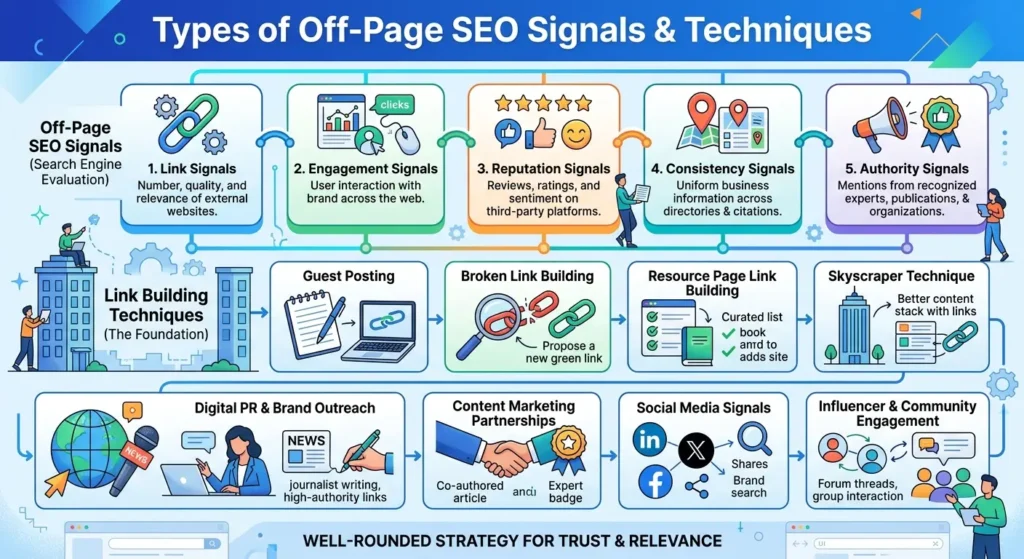
Before diving into individual tactics, it helps to understand the broader categories of signals that off-page SEO techniques are designed to influence. Search engines do not evaluate a single factor in isolation; they weigh a combination of signals to form an overall picture of trust and relevance.
- Link signals — the number, quality, and relevance of websites linking back to yours.
- Engagement signals — how users interact with your brand across the web, including click-through behavior from search and social platforms.
- Reputation signals — reviews, ratings, and sentiment expressed about your business across third-party platforms.
- Consistency signals — how uniformly your business information appears across directories, citation sites, and social profiles.
- Authority signals — mentions and endorsements from recognized experts, publications, or organizations within your industry.
Each of these categories maps directly to a set of off-page SEO techniques covered later in this guide, which is why a well-rounded strategy rarely relies on just one tactic.
Link Building: The Foundation of Off-Page SEO Techniques
When people talk about external SEO efforts, link building is usually the first thing that comes to mind — and for good reason. Backlinks remain one of the strongest ranking signals search engines use to evaluate authority. But not all links are created equal, and modern off-page SEO techniques require a much more strategic approach than simply acquiring as many links as possible.
Guest Posting
Guest posting is one of the most reliable off-page SEO techniques because it allows you to contribute genuine value to another website’s audience while earning a contextual backlink in return. The key is relevance: a guest post on a site within your niche carries far more weight than one on an unrelated domain. Effective guest posting as part of your off-page SEO strategies toolkit means pitching topics your target publication’s audience genuinely wants to read, not just inserting a link for its own sake.
Broken Link Building
Broken link building is a clever addition to any set of off-page SEO techniques. It involves finding dead links on other websites and suggesting your own content as a replacement. This approach works because webmasters generally want to fix broken links quickly, and you are offering a simple solution. If you want a deeper walkthrough, our guide on broken link building covers the process step by step.
Resource Page Link Building
Many industries maintain curated resource pages that link out to helpful tools, guides, and websites. Getting listed on these pages is another dependable example of off-page SEO techniques in action. It requires outreach and a genuinely useful resource to offer, but the payoff is often a highly relevant, long-lasting backlink.
Skyscraper and Content-Based Link Building
The skyscraper technique — creating a more comprehensive version of already popular content and reaching out to sites linking to the original — remains one of the more scalable off-page optimization efforts available today. It works because you are not asking for a favor; you are offering an upgrade. Combining this with strong on-page fundamentals from our on-page SEO checklist ensures the content you promote is actually worth linking to.
For a broader view of link acquisition strategy, our full link building strategies guide expands on each of these methods in more detail, and you can also explore additional link building techniques for further ideas.
Digital PR and Brand Outreach
Digital PR has become one of the most valuable off-page SEO techniques for brands looking to earn links at scale. Instead of pitching individual bloggers, digital PR focuses on creating newsworthy stories, original research, or data-driven content that journalists and publications want to cover naturally.
This category of off-page SEO techniques works particularly well because the links earned tend to come from high-authority news and industry sites — the kind of domains that are difficult to access through standard outreach. Original surveys, industry reports, and unique data studies are among the most effective content types for this strategy, since they give writers a genuine reason to cite your site as the source.
Guest Blogging and Content Marketing Partnerships
Beyond single guest posts, building ongoing content partnerships with other brands or creators is a sustainable off-page SEO technique. Co-authoring articles, contributing to industry roundups, or being featured in expert interview pieces all fall under this umbrella. These off-site SEO methods not only generate backlinks but also position your brand as a recognized voice within your niche, which compounds trust over time.
Social Media Signals
While social shares are not a direct ranking factor in the way backlinks are, social media still plays a supporting role among off-page SEO techniques. Active social profiles increase content visibility, which in turn increases the likelihood of earning organic backlinks and brand mentions. Sharing new content consistently across platforms like LinkedIn, X, and Facebook helps content reach audiences who may cite or link to it later.
Social media also strengthens brand search demand — when more people search for your brand name directly, it reinforces the trust signals your other campaigns are already building.
Influencer and Niche Community Engagement
Partnering with influencers or established voices in your industry is another practical application of external SEO efforts. When a respected figure shares or references your content, it exposes your brand to an engaged, relevant audience and often leads to secondary link mentions from their followers or affiliated sites.
Participating in niche communities — Reddit threads, industry Slack groups, or specialized forums — can also function as effective off-page SEO techniques when done authentically. The goal is never to spam links; it is to become a recognized, helpful contributor whose website naturally gets referenced when relevant.
Forum Posting and Q&A Platforms
Contributing thoughtful answers on platforms like Quora or industry-specific forums remains a legitimate part of many off-page SEO techniques strategies. These platforms often rank well in search results themselves, so a well-placed, genuinely useful answer can drive both referral traffic and brand visibility. As with social engagement, authenticity is essential — off-page SEO strategies built on genuine expertise outperform those built on volume.
Local SEO Techniques: Citations and Reviews
For businesses serving specific geographic areas, local-focused off-page SEO techniques are essential. Two of the most important are local citations and online reviews.
Local Citations
A citation is any online mention of your business name, address, and phone number (NAP), typically on directories like Google Business Profile, Yelp, or industry-specific listings. Consistent, accurate citations are foundational off-page SEO techniques for local search visibility. Our detailed guide on local citations explains how to build and maintain them correctly, and you can compare approaches with this additional resource on local citations as well.
Online Reviews
Reviews function as a trust-based off-page SEO technique that influences both rankings and conversion rates. A steady stream of genuine, recent reviews signals to search engines — and to potential customers — that your business is active and reputable. If you want practical tactics for generating more reviews, this guide on getting more Google reviews is a useful companion resource. Optimizing your listing itself is equally important; see our guide to Google Business Profile optimization for the full picture.
Brand Mentions (Linked and Unlinked)
Not every mention of your brand comes with a hyperlink, but even unlinked mentions are increasingly recognized as meaningful off-page optimization efforts. Search engines can associate your brand name with your website through contextual signals, meaning consistent, positive mentions across the web — even without a direct link — contribute to overall authority.
Monitoring these mentions with tools that track brand citations allows you to identify unlinked references and reach out to request a link, effectively converting a passive mention into an active, authority-building asset.
Podcast Appearances and Video Collaborations
Being featured as a guest on podcasts or collaborating on video content with other creators has become one of the more modern off-page SEO techniques. Show notes almost always include a link back to the guest’s website, and audiences who enjoy the conversation frequently seek out the brand afterward. This technique blends authority building with direct audience engagement, making it one of the more efficient off-site SEO methods for time invested.
Off-Page SEO Techniques for Local Businesses vs. E-Commerce Brands
The right mix of off-page SEO techniques often depends on the type of business you run. Local service businesses — plumbers, dentists, salons — typically see the fastest results from citation building, review generation, and Google Business Profile optimization, since these signals directly influence the local map pack. E-commerce and content-driven brands, on the other hand, tend to benefit more from digital PR, influencer partnerships, and large-scale link building campaigns that target national or global search visibility.
That said, the two approaches are not mutually exclusive. A local business with an active blog can still benefit from guest posting and resource link building, while an e-commerce brand serving specific regions can gain ground through localized citations and location-based partnerships. The key is matching your off-page SEO techniques to where your target customers are actually searching and which trust signals matter most for your specific niche.
Best Practices for Applying Off-Page SEO Techniques
Not all off-page SEO techniques are equal, and applying them carelessly can do more harm than good. Keep these best practices in mind:
- Prioritize relevance over volume. A handful of links from relevant, authoritative sites will outperform dozens of links from unrelated or low-quality domains.
- Diversify your link profile. Relying on a single type of off-page SEO strategy — such as only guest posting — makes your backlink profile look unnatural. Mix guest content, citations, PR, and community engagement.
- Focus on earning, not buying. Paid links violate search engine guidelines and put your site at risk of penalties. Sustainable off-page SEO techniques are built on genuine value exchange.
- Track anchor text distribution. Over-optimized anchor text across your external SEO efforts can trigger algorithmic scrutiny. Aim for natural variation.
- Pair off-page work with strong on-page and technical foundations. Even the best off-page SEO techniques cannot compensate for a site with major technical issues. Review our technical SEO checklist or this overview of technical SEO to ensure your foundation is solid before scaling outreach.
- Be patient. Off-page SEO techniques typically take weeks or months to show measurable ranking impact, especially in competitive niches.
Common Mistakes to Avoid With Off-Page SEO Techniques
Even experienced marketers fall into these traps when executing off-page SEO techniques:
- Chasing low-quality directories. Submitting to spammy, irrelevant directories does little for authority and can dilute trust signals.
- Ignoring niche relevance. A backlink from an unrelated industry rarely carries the same weight as one from a topically relevant source.
- Neglecting brand consistency. Inconsistent business names, addresses, or descriptions across citation sites confuses both users and search engines.
- Over-reliance on a single channel. Depending entirely on guest posting or entirely on social signals leaves your off-page SEO strategies strategy fragile and easy to disrupt.
- Forgetting to track results. Without measurement, it is impossible to know which off-page SEO techniques are actually driving ranking improvements.
Useful Tools for Executing Off-Page SEO Techniques
Having the right tools makes it far easier to plan, execute, and monitor your campaigns. A few categories worth exploring include:
- Backlink analysis tools (Ahrefs, SEMrush, Moz) — useful for auditing your current link profile and researching competitor backlinks before launching new outreach.
- Citation management platforms (BrightLocal, Moz Local, Yext) — help maintain consistent NAP data across dozens of directories at once.
- Outreach and prospecting tools (Pitchbox, Hunter, BuzzStream) — streamline the process of finding contacts and managing guest posting or digital PR campaigns.
- Brand monitoring tools (Google Alerts, Mention, Brand24) — surface unlinked brand mentions so you can follow up and request attribution.
- Review management platforms — centralize review requests and responses across Google, Yelp, and industry-specific sites.
None of these tools replace strategy or relationship-building, but they make the execution side of your off-page SEO techniques considerably more efficient, especially as your campaigns scale across multiple channels.
How to Measure the Success of Off-Page SEO Techniques
Tracking the performance of your off-page SEO techniques is just as important as executing them. A few key metrics to monitor include:
- Referring domains — the number of unique websites linking to yours, a core indicator of authority growth.
- Domain authority or domain rating — third-party metrics that estimate overall backlink strength.
- Organic traffic trends — increases in organic sessions often correlate with successful off-page optimization efforts over time.
- Keyword ranking movement — track target keywords to see whether your campaigns are translating into visible ranking gains.
- Referral traffic — direct visits coming from the sites where your content or brand is mentioned.
- Review volume and sentiment — for local businesses, this reflects the health of your local reputation-building work.
Tools like Google Search Console, Ahrefs, and SEMrush are commonly used to monitor these metrics. Pairing this with a solid understanding of what SEO is and how it fits into a broader marketing strategy helps you interpret these numbers correctly.
Off-Page SEO Techniques and the Role of AI
As search continues to evolve, AI tools are beginning to influence how marketers research, execute, and monitor off-site SEO methods. From identifying link prospects to analyzing competitor backlink profiles, AI-assisted workflows are making certain off-page SEO techniques faster to execute at scale. That said, human judgment remains essential — outreach that feels automated or generic tends to underperform compared to personalized, relationship-driven efforts. For more on this shift, see our guide on AI and SEO and our roundup of AI SEO tools.
Building a Long-Term Off-Page SEO Techniques Strategy
The most successful websites do not treat off-page SEO techniques as a one-time project. Instead, they build ongoing systems: regular content creation worth linking to, consistent outreach, active social presence, and continuous citation and review management. Combining these efforts with a clear SEO strategy and strong on-page SEO ensures that both sides of the optimization equation are working together rather than in isolation.
A helpful way to structure this long-term approach is to treat your external SEO efforts calendar the same way you would a content calendar — planning outreach campaigns, PR pushes, and review-generation efforts on a recurring schedule rather than in occasional bursts.
Conclusion
Off-page SEO techniques are not optional extras — they are a core pillar of any serious search strategy. From link building and digital PR to local citations, reviews, and brand mentions, each of these approaches contributes to the trust and authority search engines use to rank your site. The businesses that consistently invest in high-quality, relevant off-page SEO techniques — rather than chasing shortcuts — are the ones that build durable, long-term visibility in search results.
Start by auditing where your site currently stands: how many quality backlinks do you have, how consistent are your citations, and how active is your brand across relevant communities? From there, prioritize the off-page SEO strategies that align best with your industry and resources, and build outward from a foundation of genuinely valuable content and relationships.
Remember that no single tactic works in isolation. The strongest results come from combining several off-page SEO techniques into a cohesive strategy — one that is reinforced by solid on-page content and a technically sound website. Treat this as an ongoing discipline rather than a checklist to complete once, and revisit your approach regularly as your industry, competitors, and search engine algorithms continue to evolve.
Frequently Asked Questions
What is the difference between on-page and off-page SEO techniques? On-page SEO covers elements you control directly on your site, such as content and HTML structure. Off-page SEO techniques involve external actions — like link building, citations, and brand mentions — that build authority from outside sources.
How long do off-page SEO techniques take to show results? Most off-page optimization efforts take several weeks to a few months to influence rankings, depending on competition and the quality of the signals earned.
Are off-page SEO techniques still important in 2026? Yes. Despite algorithm updates and the rise of AI-driven search, off-page SEO techniques remain one of the strongest indicators of trust and authority that search engines use.
What is the single most effective off-page SEO technique? There is no universal answer, but high-quality link building through relevant, authoritative sources consistently ranks among the most impactful off-site SEO methods across industries.