If you have ever typed a question into Google and clicked one of the first few results, you have already experienced the outcome of SEO in action. But what is SEO, exactly, and why does almost every serious website owner talk about it? This guide answers what is SEO in plain language, walks through how it actually works, and shows you how to start using it on your own website — even if you have never touched a line of code.
By the end of this article, you will not just know what is SEO in theory. You will understand how search engines decide which pages deserve the top spots, which parts of SEO matter most for beginners, and how to avoid the mistakes that quietly sabotage most new websites.
What Is SEO? The Simple Definition
What is SEO in one sentence? SEO stands for Search Engine Optimization, and it is the practice of improving a website so that search engines like Google can understand it, trust it, and rank it higher for relevant searches. When people ask what is SEO, they are usually asking how a business or blog can show up on the first page of Google without paying for ads.
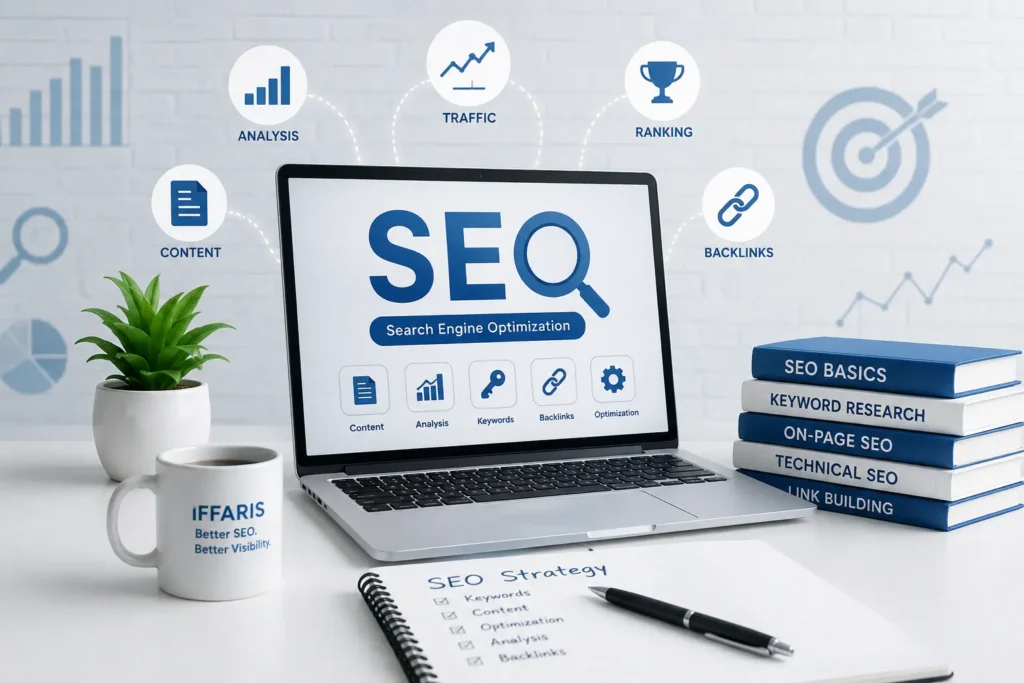
Unlike paid advertising, SEO is about earning visibility through relevance, authority, and technical quality. That is the core of what is SEO actually means in practice: instead of renting attention with ad spend, you are building a website that search engines want to recommend because it genuinely serves the person searching.
To fully answer what is SEO, it helps to break it down into three connected ideas:
- Relevance — does your content actually match what the searcher is looking for?
- Authority — do other trustworthy sources treat your website as credible?
- Experience — is your website fast, mobile-friendly, and easy to use?
Every SEO strategy, no matter how advanced, ultimately comes back to those three ideas. If you remember nothing else from this guide, remember that what is SEO boils down to making your website the best possible answer to a real question someone is typing into a search engine.
Why SEO Matters for Every Website
Now that we have covered the basic definition, let’s look at why what is SEO matters so much for anyone running a website, blog, or online business.
Search engines are the starting point for most online journeys. Whether someone is looking for a local electrician, comparing software tools, or researching a medical symptom, they usually start with a search engine rather than typing a website address directly. If your site is not visible in those results, you are invisible to a huge share of your potential audience — no matter how good your product or content actually is.
This is where understanding what is SEO becomes a business decision, not just a technical one. Paid ads can bring visitors instantly, but that traffic disappears the moment you stop paying. SEO, on the other hand, builds compounding value. A well-optimized page published today can keep bringing in visitors for years with little ongoing cost. That long-term return is one of the biggest reasons business owners take the time to learn what is SEO and how to apply it correctly.
There is also a trust factor. Many users instinctively trust organic search results more than paid ads, because they know a search engine’s algorithm — not a bidding system — decided that page deserves to rank. Ranking well is a form of third-party validation, and it is a major reason what is SEO continues to be one of the highest-value skills in digital marketing.
How Search Engines Actually Work
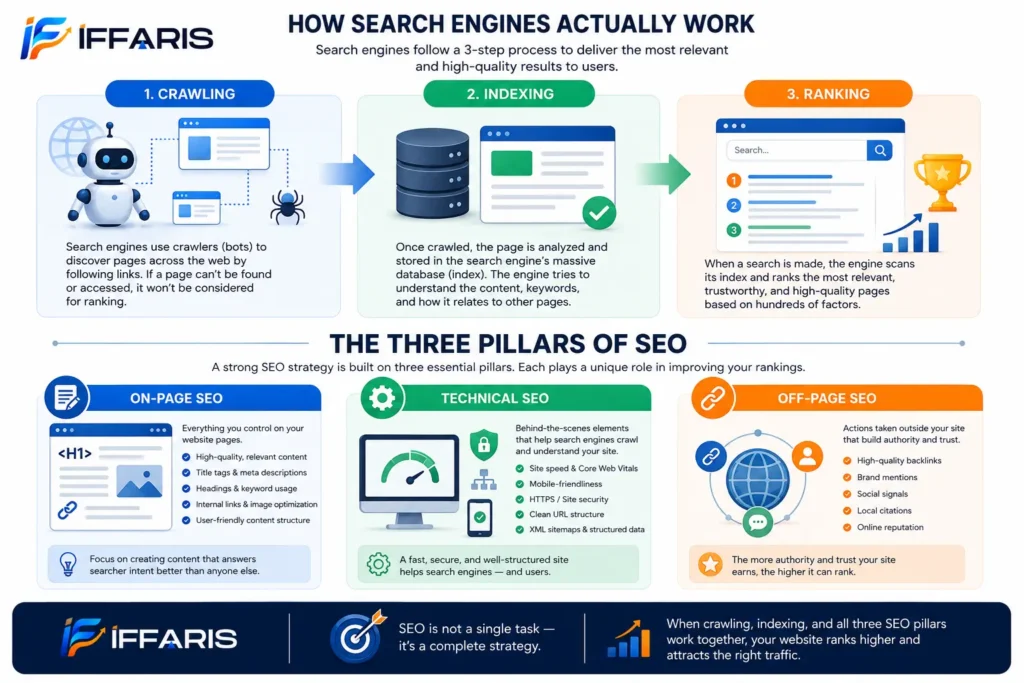
To go deeper into what is SEO, you need to understand the three-step process search engines use to build their results pages: crawling, indexing, and ranking.
1. Crawling
Search engines use automated programs called crawlers (or bots) to discover pages across the web. These crawlers follow links from page to page, constantly finding new and updated content. If a crawler cannot find or access your page, it cannot be considered for ranking — which is why technical accessibility is one of the first things any explanation of what is SEO needs to cover.
2. Indexing
Once a page is crawled, the search engine analyzes its content and stores it in a massive database called an index. During indexing, the search engine tries to understand what the page is about, what keywords it targets, and how it relates to other pages on similar topics. This step is central to what is SEO because a page that is not properly indexed simply cannot appear in search results, regardless of how good the content is.
3. Ranking
When someone performs a search, the engine scans its index and ranks the most relevant, trustworthy, and high-quality pages at the top. Ranking algorithms consider hundreds of factors, including keyword relevance, page speed, mobile usability, backlinks, and overall content quality. This ranking stage is the part most people think of when they ask what is SEO, but as you can see, it depends entirely on the crawling and indexing steps that come before it.
The Three Pillars of SEO
A complete answer to what is SEO always includes its three main pillars: on-page SEO, technical SEO, and off-page SEO. Each one plays a different role, and neglecting any single pillar will hold back your results.
On-Page SEO
On-page SEO refers to everything you control directly on your website’s pages — titles, headings, content quality, internal links, images, and keyword usage. This is usually the first area beginners explore when learning what is SEO, because it does not require technical skills, just careful writing and structure.
Good on-page SEO means writing content that thoroughly answers the searcher’s question, organizing it with clear headings, and using your target keyword naturally throughout the page. It also means writing a compelling meta title and description, since these are what actually appear in the search results and influence whether someone clicks your link.
Technical SEO
Technical SEO covers the behind-the-scenes elements that help search engines crawl and understand your site efficiently. This includes site speed, mobile-friendliness, secure connections (HTTPS), clean URL structures, XML sitemaps, and structured data. Anyone serious about what is SEO eventually has to address technical SEO, because even the best content can underperform on a slow or poorly structured website. For a deeper technical breakdown, Guide to technical SEO covers many of the underlying mechanics in more detail.
Core Web Vitals — a set of metrics measuring loading speed, interactivity, and visual stability — have become an important part of technical SEO in recent years. A website that loads slowly or shifts around while loading will struggle to rank well, no matter how well the rest of its SEO is handled. Core Web Vitals guide walks through how these metrics are actually measured.
Off-Page SEO
Off-page SEO refers to actions taken outside your own website that influence your rankings, most notably backlinks — links from other websites pointing to yours. Search engines treat backlinks as votes of confidence: the more high-quality, relevant sites that link to you, the more authoritative your site appears. When people ask what is SEO looks like beyond their own website, off-page SEO and link building are usually the answer. Link building techniques guide is a useful next read if you want to go deeper.
Off-page SEO also includes things like brand mentions, social signals, and local citations, all of which help reinforce that your website is a trustworthy, established presence in your industry or niche.
Keyword Research: The Foundation of SEO
You cannot fully understand what is SEO without understanding keyword research. Keywords are the actual words and phrases people type into search engines, and keyword research is the process of finding which ones are worth targeting.
Good keyword research balances three factors: search volume (how many people search for it), competition (how hard it is to rank for), and intent (what the searcher actually wants). A page built around the wrong keyword — even a well-written one — will struggle to attract visitors, which is why keyword research sits at the foundation of any serious approach to what is SEO.
Beginners often make the mistake of targeting keywords that are too broad or too competitive. A newer website is usually better served by targeting specific, lower-competition phrases first, then gradually building authority to compete for bigger terms. This is a core strategic lesson inside what is SEO that many beginners learn the hard way.
Local SEO: SEO for Location-Based Searches
If your business serves customers in a specific city or region, local SEO is a critical piece of what is SEO you cannot ignore. Local SEO focuses on helping your business appear in location-based searches, such as “electrician near me” or “best coffee shop in [city].”
The most important tool for local SEO is a properly optimized Google Business Profile, which controls how your business appears in Google Maps and local search results. Accurate business information, consistent citations across directories, and genuine customer reviews all play a role in local rankings. Google Business Profile ranking factors guide breaks down exactly what influences these local rankings. For any local business owner asking what is SEO can do for them specifically, local SEO is usually where the fastest, most measurable results appear — and local SEO guide for small businesses is a solid next step.
SEO vs. PPC: Two Different Paths to Visibility
A question that naturally follows what is SEO is how it compares to PPC (pay-per-click) advertising. Both approaches aim to get your website in front of people who are actively searching, but they work in fundamentally different ways.
PPC campaigns, such as Google Ads, place your website at the top of search results almost instantly, but only for as long as you continue paying for each click. The moment your budget runs out, that visibility disappears completely. SEO, by contrast, is slower to build but does not disappear the moment you stop spending money — which is exactly why so many business owners eventually ask what is SEO and how it can reduce their long-term dependence on advertising costs.
That said, SEO and PPC are not mutually exclusive. Many successful businesses run both at the same time: PPC for immediate visibility on high-value keywords, and SEO for sustainable, compounding traffic over the long run. Understanding what is SEO does not mean you have to abandon paid advertising entirely — it simply means you are diversifying how your website earns visibility, rather than depending on a single channel.
Choosing the Right SEO Strategy for a Small Business
Not every business needs the same approach to SEO. A local plumber, a national e-commerce brand, and a niche software company will all answer what is SEO differently in terms of priorities, even though the underlying principles stay the same.
For a small, local business, the fastest wins usually come from local SEO — an optimized Google Business Profile, consistent name-address-phone information across directories, and genuine customer reviews. For an e-commerce store, technical SEO and product-page optimization tend to matter more, since thousands of pages need to be crawlable and fast. For a content-driven website or blog, on-page SEO and consistent publishing are usually the priority.
This is why any useful explanation of what is SEO has to go beyond a single definition and account for the type of website involved. The tactics that work for a national retailer will not necessarily be the right starting point for a single-location service business, and vice versa.
Content Quality and SEO
Search engines have become remarkably good at distinguishing genuinely useful content from thin, keyword-stuffed pages built only to manipulate rankings. This is one of the most important shifts anyone learning what is SEO today needs to understand: quality and relevance now matter more than raw keyword repetition.
Great SEO content answers the searcher’s question completely, is well organized, and is easy to read. It uses the target keyword naturally rather than forcing it into every sentence, and it includes supporting details, examples, and structure — like headings and bullet points — that make the page easy to scan. This balance between keyword optimization and genuine usefulness is really the heart of modern what is SEO best practice.
Common SEO Mistakes Beginners Make
Understanding what is SEO also means understanding what not to do. Here are some of the most common mistakes that hold new websites back:
- Keyword stuffing — repeating a keyword unnaturally throughout a page, which search engines penalize rather than reward.
- Ignoring page speed — a slow-loading website frustrates visitors and search engines alike.
- Skipping meta titles and descriptions — leaving these blank or generic reduces click-through rates from search results.
- Publishing thin content — short, low-effort pages rarely satisfy searcher intent or rank well.
- Neglecting mobile users — most searches now happen on mobile devices, so a non-responsive site is a serious handicap.
- Ignoring internal linking — failing to connect related pages on your own site makes it harder for both users and search engines to navigate your content.
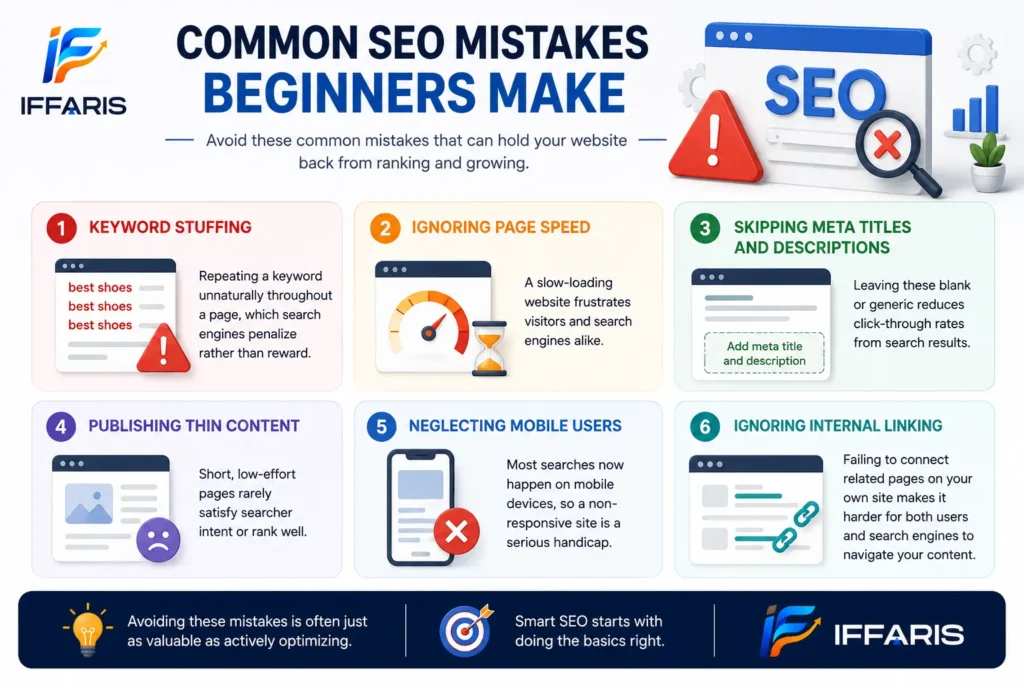
Avoiding these mistakes is often just as valuable as actively optimizing, and it is a part of what is SEO that beginners frequently overlook.
How Long Does SEO Take to Work?
One of the most common follow-up questions after learning what is SEO is how long it takes to see results. Unlike paid ads, which can drive traffic instantly, SEO is a gradual process. Search engines need time to crawl, index, and evaluate your content, and rankings typically improve over weeks and months rather than days.
Most experienced marketers expect meaningful movement within three to six months, with stronger results building over a year or more as your site accumulates authority. This timeline is a normal part of what is SEO, and it is one reason patience and consistency matter so much more than trying to find shortcuts.
Essential SEO Tools for Beginners
Once you understand what is SEO conceptually, having the right tools makes execution much easier. A few categories worth exploring:
- Google Search Console — shows how your site performs in search results, including which queries bring in traffic and any indexing issues. guide to Google Search Console is a helpful primer if you have never used it before.
- Keyword research tools — help identify search volume, competition, and related keyword opportunities.
- SEO plugins for WordPress (like Rank Math or Yoast) — simplify on-page optimization tasks like meta titles, descriptions, and readability checks.
- Page speed testing tools — highlight technical issues slowing down your website.
- Backlink analysis tools — show which sites link to you and help you evaluate your off-page SEO progress.
These tools do not replace strategy, but they make it much easier to apply everything you have learned about what is SEO consistently over time.
How to Start Implementing SEO Today
Reading about what is SEO is useful, but applying it is what actually moves the needle. Here is a simple, practical starting sequence for a beginner:
- Pick one primary keyword per page. Do not try to target ten different ideas on a single page. Focused pages consistently outperform unfocused ones.
- Write a genuinely useful page. Answer the question behind the keyword completely, using clear headings and simple language.
- Optimize your meta title and description. These directly affect whether someone clicks your result once it appears in search.
- Set up Google Search Console. This free tool shows exactly how Google sees your site and flags indexing problems early.
- Improve your site’s loading speed. Compress images, remove unnecessary scripts, and choose reliable hosting.
- Build internal links between related pages. This helps both users and search engines understand how your content connects.
- Earn a handful of quality backlinks. A few relevant, trustworthy links matter far more than dozens of low-quality ones.
Following this sequence will not make a website rank overnight, but it builds the foundation that every successful what is SEO strategy is built on. Consistency matters more than intensity — a steady publishing and optimization schedule will outperform occasional bursts of effort almost every time.
Frequently Asked Questions About SEO
Is SEO free?
SEO itself does not require ad spend, but it does require time, content creation, and sometimes tools or professional help. This is one of the more nuanced parts of what is SEO — it is not literally free, but it avoids the ongoing cost of paid advertising.
Can I do SEO myself?
Yes. Many of the fundamentals of what is SEO — like writing clear content, choosing the right keywords, and organizing your pages well — are things any website owner can learn and apply without hiring an agency.
Does SEO ever stop being necessary?
No. Search engines regularly update their algorithms, competitors keep publishing new content, and user behavior shifts over time. Ongoing attention to what is SEO is necessary to maintain and grow rankings, not just achieve them once.
What is the difference between SEO and SEM?
SEM (Search Engine Marketing) typically refers to paid search advertising, while what is SEO describes the organic, unpaid side of search visibility. Many businesses use both together for a complete search strategy.
Do I need to hire an agency to do SEO?
Not necessarily. Small websites can absolutely handle the basics of what is SEO in-house, especially the on-page fundamentals. Larger or more competitive websites often benefit from professional help, particularly for technical SEO audits and link building at scale.
How is SEO different for local businesses versus national brands?
Local businesses answering what is SEO usually focus on Google Business Profile optimization and location-based keywords, while national brands tend to prioritize broader keyword coverage, content depth, and large-scale technical SEO across many pages.
Common SEO Myths Worth Ignoring
As you continue exploring what is SEO, you will inevitably run into outdated or misleading advice. A few myths are worth clearing up early:
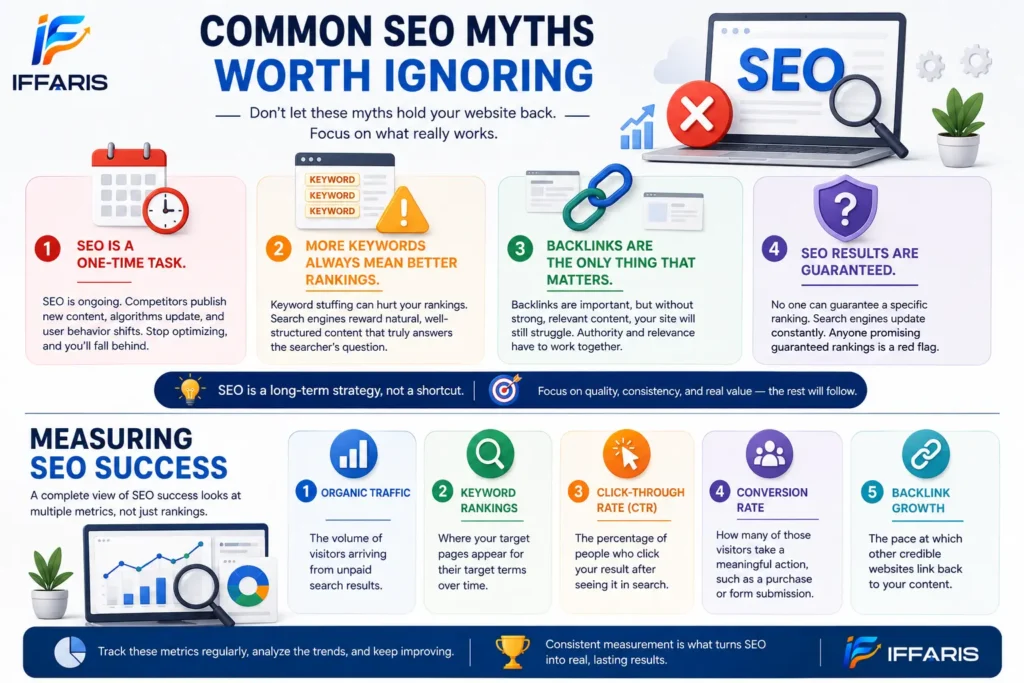
“SEO is a one-time task.” In reality, SEO is ongoing. Competitors publish new content, algorithms update, and user behavior shifts, so websites that stop optimizing after an initial push often lose ground over time.
“More keywords always mean better rankings.” Stuffing a page with repeated keywords does not help — and can actively hurt — rankings. Modern search engines reward natural, well-structured writing that clearly answers the searcher’s question, not mechanical repetition.
“Backlinks are the only thing that matters.” Backlinks are important, but a site with strong links and weak, thin content will still struggle. Authority and relevance have to work together.
“SEO results are guaranteed.” No ethical SEO professional can guarantee a specific ranking position, because search engines control their own algorithms and update them constantly. Anyone promising guaranteed rankings is a red flag.
Clearing up these misconceptions is an important part of understanding what is SEO realistically, rather than chasing shortcuts that rarely hold up over time.
Measuring SEO Success
It is easy to focus only on rankings, but a complete view of what is SEO success looks at several metrics together:
- Organic traffic — the volume of visitors arriving from unpaid search results.
- Keyword rankings — where your target pages appear for their target terms over time.
- Click-through rate (CTR) — the percentage of people who click your result after seeing it in search.
- Conversion rate — how many of those visitors take a meaningful action, such as making a purchase or filling out a contact form.
- Backlink growth — the pace at which other credible websites link back to your content.
Tracking these metrics consistently, rather than checking rankings once and walking away, is what separates a genuine SEO strategy from a one-off experiment. This ongoing measurement is just as much a part of what is SEO as the initial optimization work itself.
Conclusion: Putting SEO Into Practice
So, what is SEO, really? It is the ongoing practice of making your website as relevant, trustworthy, and user-friendly as possible so that search engines — and the people using them — find real value in recommending it. It combines on-page writing, technical performance, and off-page authority into one long-term strategy for visibility.
If you are just starting out, do not try to master every aspect of what is SEO at once. Begin with solid keyword research, write genuinely helpful content, make sure your site loads quickly and works well on mobile, and gradually build your site’s authority through legitimate links and citations. Over time, these consistent efforts compound, and the results — steady, sustainable organic traffic — are exactly why so many businesses treat learning what is SEO as one of the best long-term investments they can make in their website.
Whether you manage a small local business, a growing blog, or an established company website, the fundamentals covered in this guide give you a solid foundation for everything else you will learn about SEO going forward. For more foundational guides like this one, browse our SEO Basics category or explore the full SEO resource hub, including topics like AI and SEO for a look at where search is headed next.