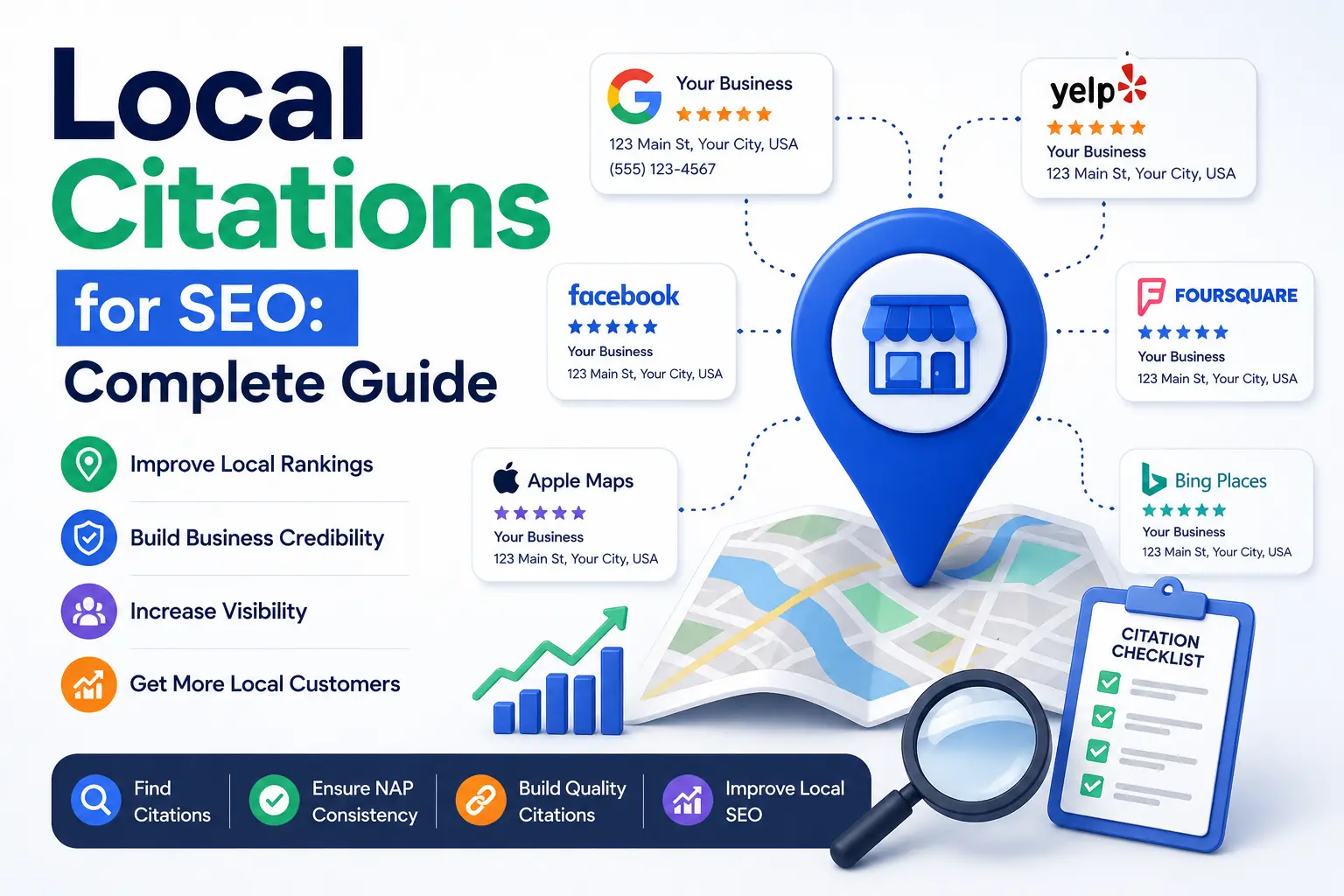
If your business serves customers in a specific city or region, this kind of listing data is one of the most overlooked ranking factors you’re probably not paying enough attention to. Search engines use them as trust signals to confirm that your business is real, active, and located where you say it is. In this complete guide, you’ll learn exactly what local citations are, why they matter, where to build them, and how to fix the mistakes that quietly hold local businesses back in search results.
Whether you’re a plumber, a dentist, a law firm, or a local retail shop, understanding this data is essential if you want to compete for the map pack and organic local rankings. By the end of this guide, you’ll know how to audit, build, and maintain local citations the right way.
What Are Local Citations?
Local citations are any online mention of your business’s name, address, and phone number — commonly shortened to NAP — on a website, directory, or platform that isn’t your own. These mentions don’t always include a link back to your site, which is what separates them from traditional backlinks.
Citations can appear on:
- Business directories (Yelp, Yellow Pages, Bing Places)
- Data aggregators (Data Axle, Foursquare, Neustar Localeze)
- Industry-specific directories
- Chamber of commerce websites
- Local news sites and blogs
- Social media business profiles
Every time your business name, address, and phone number appear consistently across the web, you’re reinforcing to Google that your business is legitimate. This is the core reason this kind of citation data matters so much for local search visibility.
Why Local Citations Matter for Local SEO
Search engines can’t physically verify a storefront, so they rely on signals scattered across the internet to confirm a business exists and operates where it claims. These listings are one of the strongest of these signals, and they play a direct role in how Google ranks businesses in the local map pack.
Here’s why local citations deserve a real strategy rather than an afterthought:
- Trust and verification – Consistent citations confirm your business details are accurate.
- Local pack rankings – Citation volume and consistency are known ranking factors for map pack visibility.
- Referral traffic – Many directories send direct traffic, not just SEO value.
- Competitive parity – If competitors have more consistent citations than you, they often outrank you even with similar content.
- Foundation for other local SEO work – Citations support everything else you do, including your Google Business Profile optimization.
Businesses that ignore this side of local SEO often struggle to rank locally no matter how good their website or content is, because the trust signals search engines look for simply aren’t there.
Local Citations vs. Backlinks: What’s the Difference?
A common point of confusion is how this kind of listing differs from backlinks. A backlink is a hyperlink from one website to another, typically used to pass authority. A citation, on the other hand, may or may not include a link — what matters most is the consistent mention of your NAP information.
That said, many of these sources do include a link, which means a strong citation-building campaign can also contribute to your broader link building strategy. If you’re also focused on earning traditional backlinks, our guide on how to get backlinks pairs well with the citation-building process described below.
Structured vs. Unstructured Local Citations
There are two main categories of business listings, and understanding the difference helps you plan where to focus your effort.
Structured Citations
Structured citations appear on dedicated business directory pages where your NAP information sits in clearly defined fields — think Yelp, Google Business Profile, or Yellow Pages. These are the easiest citations to build and manage because they follow a predictable format.
Unstructured Citations
Unstructured citations appear within regular content — a blog post, a news article, or a local event page that mentions your business name and address in a sentence rather than a form field. These are harder to build deliberately but often carry more contextual relevance because they occur naturally.
A well-rounded strategy includes both types, though most businesses should prioritize structured citations first since they’re faster to build and easier to audit.
NAP Consistency: The Most Important Rule of Local Citations
If there’s one rule to remember about this entire discipline, it’s this: consistency matters more than volume. Your business Name, Address, and Phone number should appear in the exact same format across every citation source.
Common NAP inconsistencies that hurt your listings include:
- Using “St.” on one site and “Street” on another
- Listing a different phone number after a business relocates or changes providers
- Old business names left on outdated directories after a rebrand
- Suite or unit numbers missing from some listings
- Inconsistent formatting of business hours
Even small inconsistencies in this data can confuse search engines about which version of your business information is correct, which weakens the overall trust signal. Before building any new citations, always confirm the exact NAP format you want to use everywhere going forward.
Where to Build Local Citations
Not all citation sources carry equal weight. Here’s a breakdown of where to focus when building your listings.
Core Data Aggregators
Data aggregators distribute your business information to dozens of smaller directories automatically. Getting your details correct here has a ripple effect across the web. Key aggregators include Data Axle, Foursquare, and Neustar Localeze.
General Business Directories
These are the most recognizable citation sources:
- Google Business Profile
- Bing Places
- Yelp
- Apple Maps
- Yellow Pages
- Better Business Bureau
Industry-Specific Directories
Niche directories often carry more relevance for these listings because they signal category-specific trust. For example, service-based businesses can benefit from citation and SEO guidance built specifically for their trade, such as resources for electrician SEO, plumbing SEO, HVAC SEO, locksmith SEO, and appliance repair SEO, all of which cover citation sources unique to those industries.
Local and Regional Directories
Chamber of commerce websites, local news outlets, and city-specific business directories all contribute valuable listings, especially for businesses competing in smaller or mid-sized markets.
How to Audit Your Existing Local Citations
Before building anything new, audit what already exists. Many businesses have inconsistent or duplicate listings they don’t even know about, often left over from previous owners, old addresses, or rebrands.
Steps to audit your existing citations:
- Search your business name plus city on Google to see what surfaces.
- Use a citation tracking tool (BrightLocal, Whitespark, or Moz Local) to scan for existing listings.
- Document every inconsistency in NAP formatting.
- Flag duplicate listings for merging or removal.
- Prioritize fixes on high-authority directories first.
This audit step is often skipped, but it’s arguably the most important part of any citation-building strategy — adding new listings on top of broken, inconsistent old ones only compounds the confusion for search engines.
How to Build Local Citations Step by Step
Once your audit is complete, follow this process to build new listings correctly.
Step 1: Finalize Your NAP Format
Decide on the exact format for your business name, address, and phone number, and write it down somewhere your whole team can reference it consistently.
Step 2: Claim Your Core Profiles First
Start with Google Business Profile, Bing Places, and Apple Maps, since these carry the most local search weight. Pairing this with our guide to Google Business Profile ranking factors will help you optimize these listings beyond just claiming them.
Step 3: Expand to General Directories
Move on to Yelp, Yellow Pages, Better Business Bureau, and other major directories, always using the exact same NAP format.
Step 4: Target Industry and Local Directories
Add niche and regional directories relevant to your specific trade and city. This is where these listings start compounding in relevance.
Step 5: Monitor and Maintain
This isn’t a one-time task. Set a recurring schedule — quarterly works well for most businesses — to recheck your listings for accuracy, especially after any change to your address, phone number, or business name.
Common Local Citations Mistakes
Even experienced marketers make mistakes when managing this data. Watch out for these common pitfalls:
- Inconsistent formatting – Small differences add up across dozens of listings.
- Duplicate listings – Old and new versions of the same business confuse both users and search engines.
- Ignoring niche directories – General directories alone aren’t enough for competitive markets.
- Forgetting to update after a move – Outdated addresses in your listings can actively hurt trust signals.
- Buying cheap, low-quality citation packages – Spammy directories can do more harm than good.
- Not tracking citation sources – Without a record, it’s nearly impossible to audit or fix issues later.
Avoiding these mistakes keeps your listings working in your favor instead of quietly undermining your local rankings.
How Local Citations Interact With Reviews and Reputation
Citation sources like Google Business Profile and Yelp double as review platforms, which means this side of local SEO overlaps directly with reputation management. A business with accurate, consistent citations but no reviews will still struggle to convert visibility into customers. It’s worth pairing your citation-building efforts with a plan for getting more Google reviews, since reviews and citations reinforce each other in the eyes of both users and search engines.
If your Google Business Profile has ever been suspended or flagged, it’s also worth reviewing why that happens — our reference on Google Business Profile suspensions explains common triggers, several of which relate directly to inconsistent citation data.
How This Off-Site Work Connects to Technical SEO
While citations live off-site, they still connect to your broader technical SEO foundation. If your website itself has structural issues — slow load times, poor mobile usability, or indexing problems — strong local citations alone won’t be enough to win local rankings. It’s worth running through a full technical SEO checklist alongside your citation-building work to make sure both sides of your local SEO strategy are solid.
Similarly, if you haven’t already, connecting your site to Google Search Console lets you track how citation-driven visibility translates into actual site traffic. Our guide on how to use Google Search Console is a useful companion resource here.
Tools for Managing Your Listings
Manually tracking local citations across dozens of directories isn’t realistic for most businesses. These tools can help streamline the process:
- BrightLocal – Citation tracking, building, and audit reports.
- Whitespark – Citation finder and manual building service.
- Moz Local – Automated citation distribution and monitoring.
- Yext – Enterprise-level listing management across major platforms.
Choosing the right tool depends on your budget and how many locations you’re managing. A single-location business can often manage its listings manually with a spreadsheet, while multi-location businesses benefit from automated platforms.
Citations for Multi-Location Businesses
Managing local citations gets significantly more complex once you have more than one location. Each location needs its own accurate, unique NAP listing — never a single shared phone number or address duplicated across separate location pages, which can confuse both search engines and customers.
For multi-location businesses, it also helps to structure citations around location-specific landing pages, and to review a broader local SEO guide for small businesses to make sure each location is set up correctly from the start, not just retrofitted after listings are already live.
How This Fits Into a Broader Local SEO Strategy
Local citations are one piece of a much larger local SEO puzzle. They work best alongside a strong Google Business Profile, positive reviews, on-site local content, and technical SEO fundamentals. For a complete view of how these pieces fit together, our local SEO guide covers the full strategy beyond citations alone, and this guide to ranking on Google locally offers additional context on how citations influence map pack visibility specifically.
It’s also worth running a periodic local SEO checklist or a full SEO audit to make sure your citations, reviews, and on-site signals are all moving in the same direction rather than working against each other.
How AI Search and Voice Assistants Rely on Citation Data
As search shifts toward AI-generated answers and voice assistants, the role of consistent business data has only grown. When someone asks a voice assistant “who’s the nearest plumber open now,” the answer is pulled from structured data sources that closely resemble traditional directories — the same places your NAP information already needs to live consistently. AI-driven search overviews behave similarly, pulling from aggregated, trusted data rather than a single source. If a business’s name, address, or phone number is inconsistent across the web, these systems are more likely to surface a competitor’s cleaner, more trustworthy data instead.
This is part of a broader shift worth understanding — our piece on how AI is changing SEO goes deeper into how these systems evaluate trust signals beyond traditional ranking factors. The takeaway for citation building specifically is simple: the businesses with the cleanest, most consistent data across the widest range of trusted sources are the ones AI systems default to recommending.
A Simple Citation Audit Checklist
If you want a fast way to check your current standing before starting a full build-out, run through this short checklist:
- Google your exact business name plus city and note every result on page one.
- Check your Google Business Profile, Bing Places, Apple Maps, and Yelp listings side by side for matching NAP details.
- Search for your old address or previous business name to catch outdated listings still floating around.
- Confirm your phone number matches across every platform, including any call-tracking numbers.
- Note which directories are missing entirely so you know exactly where to expand next.
Running this checklist quarterly keeps small inconsistencies from snowballing into a confusing, contradictory footprint across the web.
Local Citations and Keyword Targeting
While citations themselves aren’t primarily a keyword play, the directory categories and business descriptions you choose still matter. Selecting the most accurate category on each platform, and writing natural, keyword-aware business descriptions where directories allow it, helps reinforce relevance alongside trust. If you’re building out location or service pages to support this effort, our guide on keyword research for local businesses is a useful companion for making sure your on-site content and your directory presence are aligned around the same terms your customers actually search for.
It’s also worth revisiting your Google Business Profile setup directly — this Google profile optimization guide walks through category selection, service descriptions, and other fields that directly intersect with how directories represent your business.
Frequently Asked Questions
How many local citations do I need? There’s no fixed number — quality and consistency matter far more than raw volume. Focus on core directories first, then expand into industry and regional listings relevant to your business.
Do these listings need a backlink to count? No. A citation is valid as long as your NAP information appears consistently, whether or not it includes a clickable link back to your site.
How long does it take for citation building to impact rankings? It varies, but most businesses see gradual improvement over one to three months as search engines re-crawl directories and update trust signals.
Can bad or inconsistent listings hurt my rankings? Yes. Inconsistent or duplicate data can confuse search engines and dilute the trust signal that accurate citation data is meant to build.
Should I hire a service to build local citations for me? It depends on your time and budget. Manual building gives you more control over quality, while services like BrightLocal or Yext save time for businesses managing multiple locations.
Citations for Service-Area Businesses Without a Storefront
Not every business operates from a public-facing storefront. Mobile services, home contractors, and businesses that travel to the customer still need a strong citation presence, but the approach differs slightly. Google allows service-area businesses to hide their exact address on Google Business Profile while still listing the cities or regions they serve, and this same logic should carry through to every other directory listing.
For these businesses, consistency in the service-area description matters just as much as NAP formatting. If one directory lists five cities served and another lists a different, overlapping set, it creates the same kind of ambiguity that inconsistent addresses cause for storefront businesses. Keep a master list of exactly which cities or zip codes you serve, and use that same list — worded consistently — everywhere you appear.
It also helps to support this off-site presence with well-structured on-site content. Building dedicated service-area pages, each optimized around a specific location and reinforced with solid on-page SEO, gives directories and search engines a consistent destination to point to, rather than sending all that citation-driven trust to a single generic homepage.
Local Citations and Overall SEO Strategy
Citation building rarely happens in isolation — it’s most effective as one thread in a wider, coordinated SEO strategy. Businesses that treat directory listings as a standalone task, separate from their content, technical SEO, and link building efforts, tend to see slower, less consistent results. For a broader view of how these pieces should work together across a full campaign, our guide to building an effective SEO strategy is a useful reference point, and revisiting the fundamentals in what SEO actually is can help frame where citation work fits into the bigger picture for teams newer to the discipline.
Conclusion
Local citations remain one of the most reliable, foundational elements of local SEO, even as search continues to evolve. Getting your NAP information accurate and consistent across the right mix of general, industry-specific, and regional directories builds the trust signals search engines need to rank your business confidently in local results. Combine strong, consistent listings with an optimized Google Business Profile, steady reviews, and solid technical SEO, and you’ll have a local search foundation that’s genuinely hard for competitors to beat.
Start by auditing what’s already out there, fix the inconsistencies, and build outward from your most important directories first, then expand into industry-specific and regional sources over time as capacity allows. This kind of work isn’t glamorous, but few local SEO tactics offer this much return for the effort involved, and the businesses that stay disciplined about it tend to hold their local rankings even as algorithms and search formats continue to shift.