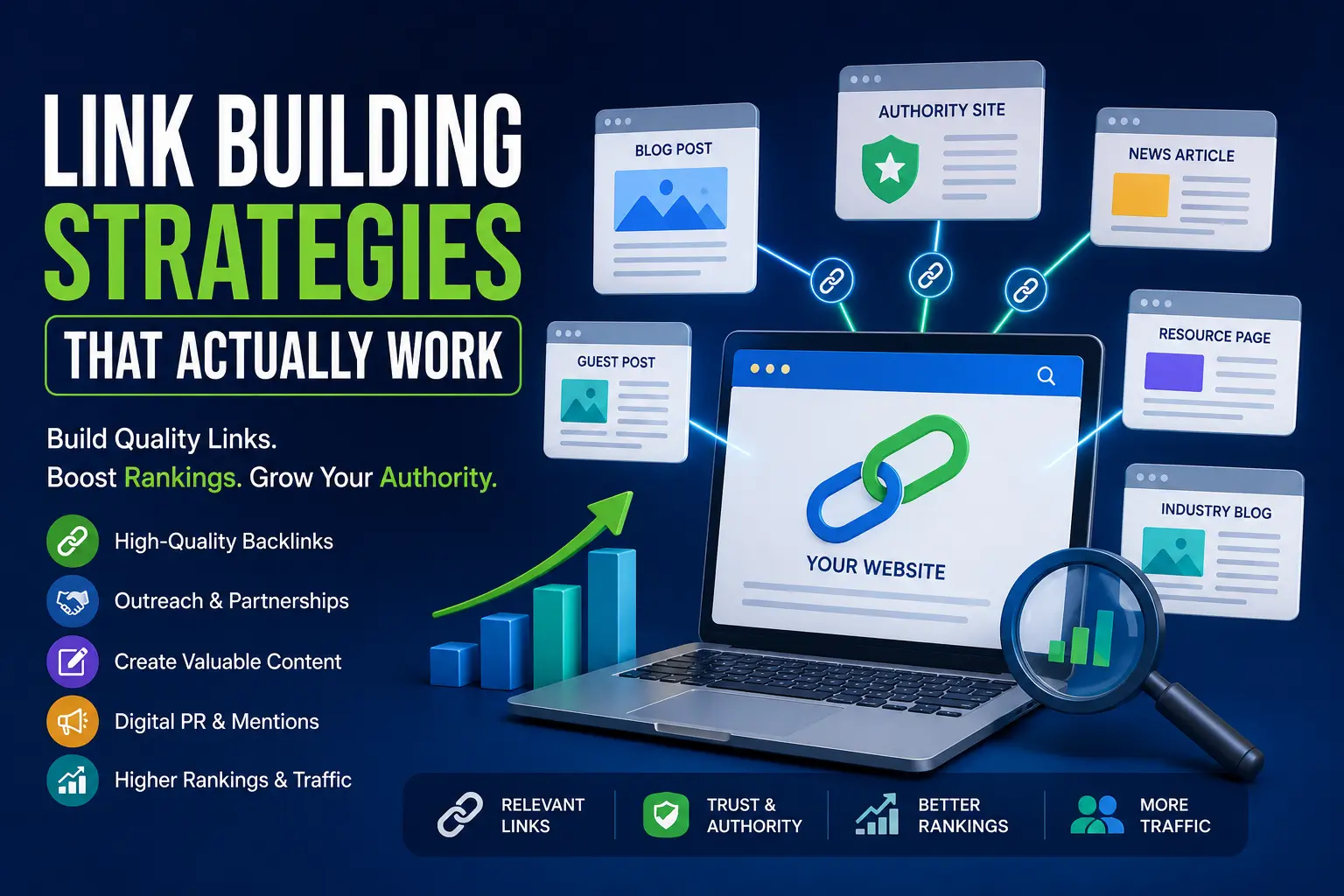
If you have spent any time researching SEO, you already know that content alone will not get you to page one of Google. You need links pointing back to your website, and you need the right link building strategies to earn them consistently. Search engines still treat backlinks as one of the strongest trust signals a website can have, which is why every serious SEO campaign is built around a set of tested link building strategies rather than random outreach emails or paid shortcuts.
In this guide, we will walk through the link building strategies that are actually working right now, why they matter, how to execute them step by step, and which mistakes quietly destroy the results of otherwise solid link building strategies. Whether you run a small blog or manage SEO for a growing brand, these link building strategies will give you a clear roadmap for building authority the right way.
What Are Link Building Strategies?
Link building strategies are the deliberate methods a website uses to acquire backlinks from other domains. A backlink is simply a link from one website pointing to another, and search engines interpret these links as votes of confidence. The more high-quality votes your site earns, the more search engines trust that your content deserves to rank.
Not all link building strategies are created equal, though. Some approaches focus on quality over quantity, targeting a handful of authoritative, relevant domains. Others rely on volume, spreading links across many smaller sites. The best tactics almost always favor relevance and authority over sheer numbers, because a single link from a respected industry publication can outweigh dozens of low-value links.
It also helps to understand what these campaigns are not. They are not about spamming blog comments, joining private blog networks, or mass-submitting your URL to unrelated directories. Genuine link building strategies are rooted in earning trust — through useful content, real relationships, and outreach that offers value to the person on the other end of the email.
Why Link Building Strategies Still Matter in 2026
Some marketers assume that with AI-driven search and changing algorithms, backlinks matter less than they used to. In reality, link building strategies remain one of the top three ranking factors search engines rely on, alongside content quality and technical SEO. Here is why solid link building strategies continue to move the needle:
- They signal trust. When authoritative sites link to you, search engines treat this as third-party validation of your credibility.
- They drive referral traffic. Good outreach campaigns do not just help rankings; they send real visitors from the linking page to yours.
- They accelerate indexing. New pages get discovered faster when they are linked from already-crawled, trusted domains.
- They build brand awareness. Consistent outreach puts your name in front of new audiences across your industry.
- They compound over time. Unlike paid ads, links earned this way keep working long after the outreach email is sent.
Because of these benefits, businesses that invest in long-term link building strategies consistently outperform competitors who rely only on on-page optimization.
Link Building Strategies: A Quick Comparison
Since new readers often want a fast overview before committing time to any single tactic, here is a quick side-by-side look at how the major approaches compare on effort, speed, and typical link quality.
| Strategy | Effort Level | Time to Results | Typical Link Quality |
|---|---|---|---|
| Guest posting | Medium | 2–6 weeks per link | High, if the host site is relevant |
| Broken link building | Medium | 2–8 weeks | High, but acceptance rates vary |
| Skyscraper technique | High (content-heavy) | 1–3 months | Very high, once content is live |
| Digital PR / HARO outreach | Low per pitch, high in volume | Days to weeks | Very high (news and media sites) |
| Resource page outreach | Low | 2–4 weeks | Medium to high |
| Competitor backlink analysis | Medium (research-heavy) | Ongoing | Varies by opportunity |
| Link reclamation | Low | Days | High (recovers existing authority) |
| Directory submissions | Low | Days | Low to medium |
This table is a starting point, not a rulebook — the right mix always depends on your industry, budget, and how much content production capacity your team has.
Core Principles Behind Effective Link Building Strategies
Before diving into individual tactics, it helps to understand the principles that separate effective link building strategies from wasted effort.
1. Relevance Beats Volume
The strongest campaigns prioritize topical relevance. A backlink from a website in your niche carries far more weight than ten links from unrelated directories.
2. Authority Matters
Domains with strong authority pass more value through their links. Any serious link building strategy should include research into a site’s authority before pursuing a link there.
3. Natural Anchor Text
Overusing exact-match anchor text is a red flag for search engines. Smart outreach mixes branded, generic, and partial-match anchors to look organic.
4. Diversity of Link Sources
Relying on a single tactic is risky. The most resilient campaigns pull links from guest posts, resource pages, digital PR, and internal linking, all working together.
5. Long-Term Consistency
Link building strategies are not a one-time project. Websites that treat link acquisition as an ongoing process see compounding returns over months and years.
The Best Link Building Strategies to Use Right Now
Below are the link building strategies that consistently deliver results across industries, from SaaS to ecommerce to local service businesses.
1. Guest Posting on Relevant Websites
Guest posting remains one of the most reliable tactics available today. The process involves writing valuable content for another website in exchange for a backlink, usually placed in the author bio or naturally within the body text.
To make this one of your top-performing link building strategies:
- Target sites with real audiences and decent domain authority, not link farms.
- Pitch topics that genuinely fit the host site’s content, not thinly veiled promotion.
- Write content as good as or better than what you publish on your own site.
- Avoid over-optimized anchor text; let the link feel like a natural citation.
2. Broken Link Building
Broken link building is a favorite among experienced SEOs because it offers genuine value to the site owner. This tactic involves finding dead links on relevant websites and suggesting your own content as a replacement.
The steps for this link building strategy are straightforward:
- Find resource pages or articles in your niche using search operators.
- Scan those pages for broken outbound links using a checker tool.
- Create or identify a piece of content on your site that fits the missing resource.
- Reach out to the webmaster, point out the broken link, and suggest your page as the fix.
Because you are solving a real problem for the site owner, broken link building tends to have higher acceptance rates than cold outreach for a brand-new link.
3. The Skyscraper Technique
Among modern outreach tactics, the skyscraper technique focuses on outperforming existing top-ranking content. You find a piece of content that already earns plenty of backlinks, create something noticeably better, and then reach out to the sites linking to the original asking them to link to your improved version instead.
This works because it removes the guesswork from content ideation; you already know the topic attracts links, so your job is simply to make a superior resource and pitch it as the upgrade.
4. Digital PR and HARO-Style Outreach
Digital PR has become one of the most scalable tactics for brands with real expertise or data to share. By responding to journalist queries through platforms that connect sources with reporters, you can earn links from major news outlets and industry publications.
To succeed with digital PR as one of your link building strategies:
- Respond quickly, since journalists work on tight deadlines.
- Provide a genuinely useful quote or statistic, not generic marketing copy.
- Include your title and website so it is easy for the journalist to credit you.
- Track pitches so you can follow up if a story hasn’t been published yet.
5. Resource Page Link Building
Many websites maintain curated resource pages listing helpful tools, guides, or services in a given industry. Getting listed on these pages is one of the simpler tactics to execute because the page’s entire purpose is to link out to useful content.
Search for phrases like “useful resources,” “recommended tools,” or “helpful links” combined with your industry keyword to find candidate pages, then reach out explaining why your content or tool belongs on their list.
6. Competitor Backlink Analysis
One of the smartest ways to build backlinks is simply reverse-engineering what already works for your competitors. Using a backlink analysis tool, you can see exactly which domains link to competing websites and pursue those same opportunities for yourself.
This approach shortens your research time dramatically because you are not guessing which sites might link to you; you already have proof that these domains link to content similar to yours.
7. Internal Linking as a Support Strategy
While internal linking does not bring external authority into your site, it is a critical companion to your external link building strategies. When you earn a backlink to one page, internal links help distribute that authority to other relevant pages across your site.
For example, if you are publishing SEO content on your blog, linking between related articles — such as connecting a guide on on-page SEO fundamentals to a piece on technical SEO audits — helps search engines understand your site structure and spreads link equity earned from your external link building strategies across more pages. If you’re building out a full content hub, browse the rest of the SEO and marketing to find natural places to connect new posts.
8. Link Reclamation
Every established website eventually accumulates unlinked brand mentions, broken backlinks, or links pointing to outdated URLs. Link reclamation is an underrated addition to any outreach plan because it recovers value you have already earned but never fully captured.
Steps to reclaim lost or unlinked value include:
- Searching for your brand name to find mentions that lack a hyperlink.
- Reaching out politely and asking the site to add a link.
- Fixing broken backlinks pointing to deleted or moved pages with proper redirects.
- Monitoring for new mentions using alert tools so you can act quickly.
9. Creating Linkable Assets
Certain types of content naturally attract more backlinks than others. Original research, industry surveys, free tools, templates, and in-depth guides all function as “linkable assets” that make your other outreach efforts far more effective, because you finally have something worth linking to.
Examples of high-performing linkable assets include:
- Original data studies with unique statistics.
- Free calculators or interactive tools.
- Comprehensive how-to guides that outperform existing resources.
- Infographics summarizing complex data visually.
10. Infographic and Visual Content Outreach
Visual content still performs well as part of a diversified link building strategy. When you design an infographic that simplifies a complex topic, you can offer it to relevant blogs for embedding, with a required attribution link back to your original page.
11. Testimonials and Case Study Link Building
An often-overlooked link building strategy involves offering testimonials to tools, software, or services you genuinely use. Many companies feature customer testimonials on their website with a link back to the reviewer’s site, making this a low-effort, high-relevance tactic.
12. Local and Niche Directory Submissions
For local businesses, submitting to reputable, industry-specific directories is still one of the practical tactics worth pursuing. The key is avoiding spammy, low-quality directories and focusing only on those with real traffic and editorial standards.
13. Building Relationships Through Community Engagement
Long-term outreach campaigns benefit enormously from genuine relationship building. Participating in industry forums, contributing to niche communities, and engaging with other creators on social platforms builds the kind of trust that eventually turns into natural backlinks and collaboration opportunities.
Link Building Strategies by Business Type
Not every business should approach link acquisition the same way. Here is how the priorities shift depending on your model.
For E-commerce Sites
Product-focused sites benefit most from linkable assets like buying guides, comparison charts, and original data on customer trends, paired with outreach to review blogs and gift-guide roundups. Digital PR also performs well here, since journalists frequently cover product trends and are open to featuring unique brands with a compelling angle.
For B2B and SaaS Companies
B2B brands tend to see the strongest returns from original research, industry surveys, and expert commentary through digital PR. Guest posting on industry publications and contributing to podcast interviews also work well, since B2B buyers trust peer-reviewed, expert-driven content more than generic promotional material.
For Local Service Businesses
Local businesses should prioritize niche directory submissions, local press mentions, and testimonials for tools or suppliers they use. Sponsoring community events or local organizations can also generate a natural backlink from the event’s website, which doubles as goodwill marketing.
Advanced Link Building Strategies for Competitive Niches
If you operate in a competitive space, basic tactics may not be enough. These advanced link building strategies can help you stand out.
Newsjacking and Trend-Based Content
Publishing timely commentary on breaking industry news can attract links from journalists and bloggers covering the same story, especially when you move fast and offer a unique angle.
Building a “Link Magnet” Content Hub
Rather than relying on individual posts, some of the most effective link building strategies involve building an entire resource hub around a topic — a cluster of interlinked guides, data, and tools that collectively becomes the go-to reference in your niche.
Podcast and Video Guesting
Appearing as a guest on podcasts or YouTube channels in your industry often results in a link from the show notes or episode description, combining brand exposure with a genuine backlink.
Strategic Partnerships and Co-Marketing
Partnering with complementary (non-competing) businesses for joint webinars, guides, or tools naturally produces cross-promotional backlinks as part of the collaboration.
Tools That Support Strong Link Building Strategies
No matter which link building strategies you choose to pursue, the right tools make execution far more efficient:
- Backlink analysis tools to study competitor link profiles, monitor your own growth, and spot toxic links that might need disavowing.
- Broken link checkers to identify dead links on target pages before you pitch a replacement resource.
- Outreach and email tools to manage sequences, track opens and replies, and personalize campaigns at scale without losing the human touch.
- Content research tools to identify which topics already attract the most links in your niche, so your next linkable asset targets proven demand.
- Rank tracking tools to measure whether your link building strategies are translating into ranking improvements for the specific pages you are building links to.
- Brand mention alerts so you can catch new unlinked citations and turn them into reclaimed links quickly.
For deeper research on backlink data and outreach benchmarks, resources like the link building research can be a useful external reference point when refining your own campaigns.
Common Mistakes That Sabotage Link Building Strategies
Even well-intentioned link building strategies can fail if you fall into these traps:
- Buying links from low-quality networks. This violates search engine guidelines and can trigger penalties that undo months of legitimate work.
- Over-optimizing anchor text. Repeating the exact same keyword-rich anchor across many links looks manipulative rather than natural.
- Ignoring relevance. A backlink from an unrelated industry rarely helps and can occasionally dilute topical trust.
- Chasing quantity over quality. A hundred weak links will never outperform ten links from respected, relevant domains.
- Treating link building as a one-time task. Sustainable link building strategies require ongoing effort, not a single sprint before a launch.
- Neglecting content quality. No outreach template can convince a site to link to weak, thin, or outdated content.
- Failing to track results. Without measurement, you cannot tell which link building strategies are actually producing ranking improvements.
How to Measure the Success of Your Link Building Strategies
Tracking results is essential to knowing whether your link building strategies are worth the time invested. Focus on these metrics:
- Referring domains growth — the number of unique websites linking to you over time.
- Domain authority movement — whether your overall site authority is trending upward.
- Keyword ranking improvements — especially for pages that received new backlinks.
- Referral traffic — direct visits coming from the linking pages themselves.
- Link velocity — the pace at which you are earning new links, which should grow steadily rather than spike unnaturally.
Reviewing these metrics monthly helps you double down on the link building strategies that are working and pause the ones that are not delivering a return.
Building a Sustainable Link Building Strategy Roadmap
Rather than picking one tactic at random, the most successful campaigns combine several link building strategies into a repeatable monthly process:
- Audit your current backlink profile to understand your starting point.
- Analyze competitor links to identify realistic opportunities.
- Create at least one linkable asset per quarter to fuel outreach.
- Run two or three outreach-based link building strategies simultaneously — for example, guest posting alongside broken link building.
- Reclaim lost links every month to recover easy wins.
- Review internal linking whenever new content is published to maximize the value of every new backlink.
- Report on results monthly so your link building strategies stay data-driven rather than guesswork-driven.
A Realistic Timeline: What to Expect Month by Month
One of the most common questions from beginners is simply “how long will this take?” Here is a realistic breakdown of what a consistent campaign typically looks like.
Month 1–2: Focus on foundational work — a backlink audit, competitor research, and producing your first linkable asset. Expect little to no visible ranking movement yet; this stage is about setup.
Month 2–4: Outreach campaigns begin landing results. Guest posts get published, resource page listings go live, and a handful of digital PR mentions start appearing. You may notice small ranking improvements on target keywords.
Month 4–6: Referring domains grow steadily, and pages that received new backlinks typically show clearer ranking gains. This is when momentum starts to compound, since earlier links continue passing authority while new ones are added.
Month 6 and beyond: With a repeatable monthly process in place, growth becomes more predictable. Teams that stay consistent through this stage usually see the strongest, most durable improvements in both rankings and referral traffic.
Patience matters here. Rushing the process by buying links or mass-submitting to low-quality sites almost always costs more in cleanup than it saves in time.
Frequently Asked Questions About Link Building Strategies
How many backlinks do I need for good rankings? There is no fixed number. Quality and relevance matter far more than raw count, so a handful of strong links from authoritative, relevant sites often outperforms hundreds of weak ones.
Are paid link building strategies safe? Paid links that violate search engine guidelines carry real penalty risk. Ethical, white-hat link building strategies focused on genuine outreach and valuable content remain the safest long-term approach.
How long does it take to see results from link building strategies? Most websites start noticing ranking movement within two to four months of consistent effort, though competitive niches can take longer.
Should beginners focus on one link building strategy or several? Beginners often see the best results by mastering one or two link building strategies, such as guest posting and resource page outreach, before expanding into more advanced tactics.
Can internal linking replace external link building strategies? No. Internal linking supports and distributes the value earned from external link building strategies, but it cannot replace the trust signals that come from other websites linking to yours.
Quick Pre-Launch Checklist
Before you kick off a new campaign, run through this short checklist to make sure your foundation is solid:
- Backlink audit completed, with any toxic links identified.
- At least one linkable asset (guide, tool, or data study) ready to promote.
- Competitor backlink gaps documented as a target list.
- Internal linking reviewed on key pages that will receive new external links.
- Outreach templates personalized, not generic mass-copy.
- Tracking spreadsheet or tool set up to log referring domains, rankings, and referral traffic monthly.
Final Thoughts
There is no single shortcut when it comes to earning authority online. The websites that consistently rank well are the ones that treat link building strategies as an ongoing discipline rather than a checkbox to tick once. By combining guest posting, broken link building, digital PR, linkable assets, and thoughtful internal linking, you create a well-rounded approach that search engines reward over time.
Start with the link building strategies that match your resources today, track your results carefully, and expand into more advanced tactics as your site’s authority grows. Done consistently, these link building strategies will not just improve your rankings — they will build a durable foundation of trust and visibility that keeps compounding for years to come.