
Every page that ranks on Google starts with a simple question: what are people actually typing into the search bar? Answering that question is the whole purpose of keyword research, and it is the first skill every new SEO needs to learn. If you pick the wrong words, even a beautifully written page can sit unseen on page five. If you pick the right ones, a modest website can pull in steady, qualified traffic month after month.
Many beginners treat keyword research as a boring spreadsheet exercise, but strong keyword research is really about people. In reality, it is closer to market research. You are listening to your future customers, learning their language, and discovering which problems they want solved. Once you understand that, the process becomes far less intimidating and far more useful.
In this beginner-friendly guide, you will learn what keyword research is, how search intent shapes your choices, which metrics matter, and how to build a keyword list step by step. You will also see which tools to use, which mistakes to avoid, and how to measure whether your efforts are working. If you are brand new to the field, it helps to first read our explainer on what is SEO and then come back here to start building your keyword foundation.
What Is Keyword Research and Why Does It Matter?
Keyword research is the process of finding, analyzing, and selecting the words and phrases that your target audience uses in search engines. The goal is to understand demand: which topics people care about, how often they search for them, and how hard it will be to compete for those searches.
Think of it as a map. Without a map, you might spend months writing about topics nobody searches for. With one, you can see exactly where the opportunity is and plan your content around it. Good keyword research answers three questions:
- What are people searching for in your niche?
- How many people search for each term, and how competitive is it?
- What do those searchers actually want when they type that phrase?
The importance of keyword research goes beyond traffic. It shapes your site structure, your page titles, your headings, your service pages, and even your product descriptions. It also tells you what to publish first. A website that ignores keyword research tends to produce content based on guesses, while a website that relies on it produces content backed by real data.
If you want to understand how search engines turn those queries into rankings, our guide on how does SEO work explains crawling, indexing, and ranking in plain language. Keyword research sits at the very start of that chain, because it decides which queries you are trying to win.

The Real Benefits of Keyword Research
When you invest time in keyword research, you gain several advantages that compound over time:
- Targeted traffic. You attract people who are already looking for what you offer.
- Better content ideas. You never run out of topics, because the data shows you what people ask.
- Lower wasted effort. You avoid competing for terms that are far too difficult for a new site.
- Improved conversions. Visitors who find you through a relevant phrase are more likely to take action.
- Clearer strategy. Your whole team can see which pages target which searches.
Understanding Search Intent Before You Pick Any Keyword
Search intent is the reason behind a search. It is the single most important concept in modern keyword research, because Google tries hard to match each result to what the searcher wants. If your page does not fit the intent, it will not rank, no matter how many times you repeat the phrase.
There are four main types of intent:
Informational intent. The searcher wants to learn something. Examples include “what is a meta description” or “how to fix slow website speed.” Blog posts, guides, and tutorials fit these searches best.
Navigational intent. The searcher wants to reach a specific site or page, such as “Google Search Console login.” You rarely win these unless you are the brand being searched.
Commercial intent. The searcher is comparing options before buying. Phrases like “best SEO tools” or “Ahrefs vs Semrush” signal this stage. Comparison pages and reviews perform well here.
Transactional intent. The searcher is ready to act, using phrases like “buy,” “hire,” “near me,” or “pricing.” Service pages, product pages, and landing pages suit these searches.

How to Check Intent Quickly
The fastest way to confirm intent is to search the keyword yourself and study the first page of results. Ask yourself what type of pages appear. Are they listicles, product pages, videos, or how-to guides? Do you see featured snippets or “People also ask” boxes? The results page is Google telling you exactly what format it believes searchers want.
During keyword research, always record the intent next to each phrase. A beginner mistake is targeting a transactional keyword with an informational article. The mismatch almost always leads to poor rankings and a high bounce rate.
Types of Keywords Every Beginner Should Know
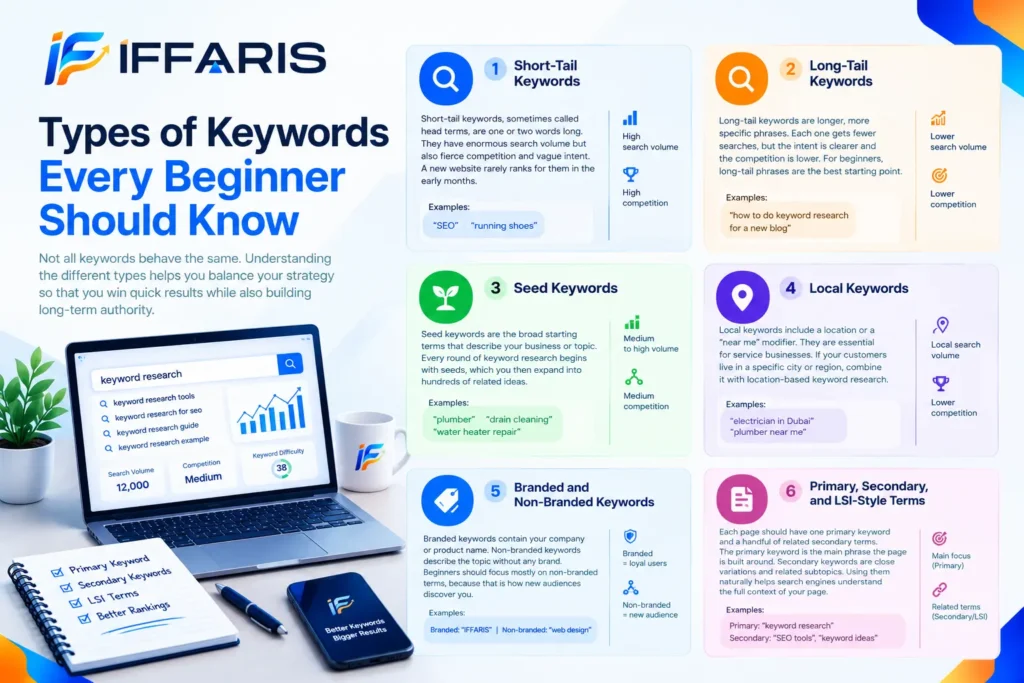
Not all keywords behave the same way. Understanding the different types helps you balance your strategy so that you win quick results while also building long-term authority.
Short-Tail Keywords
Short-tail keywords, sometimes called head terms, are one or two words long, such as “SEO” or “running shoes.” They have enormous search volume but also fierce competition and vague intent. A new website rarely ranks for them in the early months.
Long-Tail Keywords
Long-tail keywords are longer, more specific phrases, such as “how to do keyword research for a new blog.” Each one gets fewer searches, but the intent is clearer and the competition is lower. For beginners, long-tail phrases are the best starting point. You can learn much more in this detailed guide to long-tail keywords, which shows how specific phrases can bring highly qualified visitors.
Seed Keywords
Seed keywords are the broad starting terms that describe your business or topic. If you run a plumbing company, your seeds might be “plumber,” “drain cleaning,” and “water heater repair.” Every round of keyword research begins with seeds, which you then expand into hundreds of related ideas.
Local Keywords
Local keywords include a location or a “near me” modifier, such as “electrician in Dubai.” They are essential for service businesses. If your customers live in a specific city or region, you should read our local SEO guide and combine it with location-based keyword research.
Branded and Non-Branded Keywords
Branded keywords contain your company or product name. Non-branded keywords describe the topic without any brand. Beginners should focus mostly on non-branded terms, because that is how new audiences discover you.
Primary, Secondary, and LSI-Style Terms
Each page should have one primary keyword and a handful of related secondary terms. The primary keyword is the main phrase the page is built around. Secondary keywords are close variations and related subtopics. Using them naturally helps search engines understand the full context of your page without forcing repetition.
The Keyword Metrics You Need to Understand
When you start using tools for keyword research, you will see many numbers. You do not need to master all of them on day one, but you should understand the core metrics.
Search volume. This is the estimated number of times a phrase is searched each month. It helps you judge demand, but treat it as an estimate rather than an exact figure. A keyword with lower volume but strong intent can be more valuable than a high-volume term with vague intent.
Keyword difficulty. This score estimates how hard it will be to rank on the first page. Every tool calculates it differently, so compare scores within one tool rather than across tools. New websites should start with lower difficulty scores.
Cost per click. CPC shows what advertisers pay for a click on that term. A high CPC usually signals commercial value, which can help you spot keywords that lead to sales.
Click potential. Some searches never produce clicks because Google answers them directly on the results page. Checking click potential prevents you from chasing terms that give impressions but no visitors.
Trend direction. Using Google Trends, you can see whether interest in a topic is rising, falling, or seasonal. This matters for businesses such as HVAC, landscaping, and tax services, where demand shifts through the year.
Balancing Volume, Difficulty, and Intent
Beginners often sort their list by volume and pick the biggest numbers. This is a trap. A better approach is to balance three factors: the volume must be worth the effort, the difficulty must be realistic for your site, and the intent must match the page you plan to create. The best keyword research results come from phrases that satisfy all three.
Step-by-Step Keyword Research Process for Beginners
Now let us walk through a repeatable keyword research process. You can follow these steps for any website, from a personal blog to a local service business.

Step 1: Define Your Goals and Audience
Before opening any tool, write down what you want from your site. Do you want leads, sales, newsletter signups, or ad revenue? Then describe your ideal visitor. What problems do they have? What words would they use? Strong keyword research always begins with a clear picture of the audience, because every later decision depends on it.
Step 2: List Your Seed Keywords
Brainstorm ten to twenty broad terms that describe your products, services, and topics. Talk to customers, read emails, and check support questions. The phrases people use in real conversations often reveal gaps that tools miss.
Step 3: Expand With Keyword Research Tools
Paste your seed terms into a tool and review the suggestions. Most tools offer related terms, questions, and “also searched for” lists. Export everything into a spreadsheet so you can filter and sort later. At this stage, collect widely and judge later.
Step 4: Mine Google’s Own Suggestions
Google gives you free ideas directly in the search interface. Use these three sources:
- Autocomplete. Type your seed phrase and note the suggestions that appear below the search bar.
- People also ask. These questions are perfect for FAQ sections and subheadings.
- Related searches. Scroll to the bottom of the results for more variations.
This free layer of keyword research is powerful because it shows what real people are searching right now.
Step 5: Check Search Intent for Every Candidate
Take your promising phrases and search each one. Note the type of pages that rank. Decide whether your planned content fits that format. If the first page is full of product pages and you planned a blog post, choose a different keyword or change the page type.
Step 6: Evaluate Metrics and Competition
Add volume, difficulty, and CPC data to your spreadsheet. Then look at the actual competitors on page one. Are they large authority sites, or are smaller websites ranking? If small sites hold the top spots, you have a real chance. For more help finding realistic targets, see this guide on low competition keywords.
Step 7: Prioritize and Select
Score each keyword on relevance, intent match, volume, and difficulty. Pick the strongest phrases for your first batch of content. Many beginners choose around ten to twenty targets and publish them over a few weeks, then repeat the cycle.
Step 8: Map Keywords to Pages
Assign one primary keyword to each page, and never target the same primary phrase on two different pages. Doing so creates keyword cannibalization, where your own pages compete against each other. A simple spreadsheet with columns for keyword, intent, page URL, and status is enough to stay organized.
Best Tools for Keyword Research
You do not need an expensive stack to start. Many excellent options are free, and paid tools can be added later as your needs grow.
Free Tools
Google Keyword Planner. Built for advertisers, it still gives valuable ideas and volume ranges. You need a Google Ads account, but you do not need to run ads.
Google Search Console. This free tool shows the queries your site already appears for. It is one of the most underrated sources of keyword research, because it reveals real impressions and clicks. Learn the basics in our guide on how to use Google Search Console.
Google Trends. Compare topics, check seasonality, and spot rising interest.
Autocomplete and People Also Ask. As covered earlier, these cost nothing and deliver fresh ideas.
AnswerThePublic and similar question tools. These display questions, comparisons, and prepositions people use around a topic.
Paid Tools
Ahrefs. Known for its large keyword database, difficulty scores, and competitor analysis.
Semrush. Offers keyword suggestions, a Keyword Magic Tool, and strong competitive research features.
Ubersuggest and similar budget options. These are friendly for beginners and freelancers who want a lower monthly cost.
The newest wave of assistants can also speed up brainstorming and clustering. If you want to see how artificial intelligence fits into this work, read our overview of AI SEO tools. Remember, though, that AI suggestions still need to be checked against real data before you commit to them.
Which Tool Should You Choose?
Start with Search Console, Keyword Planner, and Google’s own suggestions. Once you feel comfortable, add one paid tool for deeper data. The tool matters less than the habit, because keyword research rewards consistency. A consistent keyword research routine with free tools will beat an occasional session with expensive software.
How to Analyze Competitors for Keyword Ideas
Your competitors have already done part of the work for you. Studying them reveals which keywords drive their traffic and where they are weak.
First, identify true search competitors. These are the sites that appear for your target phrases, which may differ from your business competitors. Then use a tool to see the pages that bring them the most organic traffic. Look at the topics they cover, the formats they use, and the questions they answer.
Next, look for content gaps. These are keywords your competitors rank for that you do not cover. Gap analysis is one of the fastest ways to expand a keyword list, because it targets proven demand. Also look for weak spots: thin articles, outdated pages, or posts that miss the real intent. You can often outrank those pages by creating something more complete.
Finally, study their page titles, headings, and structure. You are not copying them; you are learning what Google already rewards for each query. Then you aim to deliver a clearer, more useful, and more current answer.
Organizing Your Keywords: Clusters and Topic Groups
Once you have a long list, the next challenge is organization. Search engines no longer judge pages by a single phrase. They understand topics, so grouping related terms into clusters gives you a major advantage.
A keyword cluster is a set of closely related phrases that can be served by one page. For example, “keyword research for beginners,” “how to do keyword research,” and “beginner keyword research guide” all share the same intent. One strong page can target all three, using the main phrase as the primary keyword and the others as secondary terms.
Building Topic Clusters
A topic cluster has a central pillar page and several supporting articles. The pillar covers the broad subject, and each supporting article explores a narrower subtopic and links back to the pillar. This structure signals expertise and passes authority across your site.
For instance, a pillar about SEO fundamentals could link to supporting posts on keyword research, on-page optimization, and link building. You can see this idea in action by exploring our on-page SEO checklist and our post on link building strategies, both of which connect naturally to the keywords you choose. For a business-focused view of how all these pieces fit together, this SEO strategy article shows how to turn research into a practical growth plan.
Applying Your Keywords on the Page
Finding the right terms through keyword research is only half the job. You must place them naturally where search engines and readers expect them.
- Title tag. Include the primary keyword, ideally near the beginning, and keep the title under about 60 characters.
- Meta description. Write a persuasive summary that includes the phrase and invites the click.
- URL. Use a short, clean slug that contains the main term.
- Headings. Place the primary keyword in the H1 and use related terms in H2 and H3 headings.
- Opening paragraph. Mention the primary phrase early so both readers and crawlers understand the topic.
- Image alt text. Describe images accurately, using the keyword only when it fits.
- Internal links. Use descriptive anchor text that tells the reader what to expect.
Avoid Keyword Stuffing
Repeating a phrase too often makes content hard to read and can trigger quality problems. Aim for natural writing. A healthy keyword density generally stays below roughly two percent, and many writers keep it closer to one percent. Use synonyms, related terms, and full sentences that serve the reader first. When your keyword research is solid, you will not need to force anything, because the topic itself will lead you to the right language.
For a deeper walkthrough of every on-page element, the on-page SEO guide covers placement in detail, and the article on local SEO title tags shows how to write titles that earn clicks.
Keyword Research for Local Businesses
If you serve customers in a specific area, local keyword research follows a slightly different path. You still need seed terms and intent checks, but you add location modifiers, service areas, and “near me” patterns.
Start with your core services and combine them with cities, neighborhoods, and regions you serve. A towing company might target “24 hour towing in Houston” and “emergency tow truck near me.” An electrician might target “licensed electrician in Abu Dhabi.” Then check the map pack and local results, because the layout differs from standard searches.
Your Google Business Profile also plays a major role in local visibility, so connect your keyword work to your listing. Our guide to Google Business Profile optimization explains how to reflect your services accurately. For a step-by-step look at location-based targeting, read this article on keyword research for local businesses and the companion post on local keyword research. Finally, when you build pages for each service, the advice in service pages SEO will help you place those keywords effectively.
Common Keyword Research Mistakes Beginners Make
Everyone makes errors at the start of keyword research. Knowing the most common ones lets you avoid months of frustration.
Chasing only high volume. Big numbers look attractive, but they usually come with big competition. Start where you can win.
Ignoring search intent. A keyword that does not match your page type will not rank. Always verify intent before writing.
Targeting overly broad terms. Phrases like “marketing” or “SEO” are too vague for a new site. Use specific, long-tail variations instead.
Relying on one tool. Every tool has gaps and estimates. Cross-check important terms with Search Console and real search results.
Forgetting about the customer’s language. Industry jargon is not always what customers type. Use their words, not yours.
Creating duplicate targeting. Two pages aiming at the same primary phrase will compete. Map each keyword to one page.
Doing it once and stopping. Search behavior changes constantly. Treat keyword research as an ongoing habit, not a one-time task.
Skipping technical readiness. Even perfect targeting fails if search engines cannot crawl your pages. Review our technical SEO checklist to make sure your foundation is solid.
How to Measure Whether Your Keywords Are Working
After you publish, you need to confirm that your choices are paying off. Measuring results also feeds the next round of keyword research.
Open Google Search Console and review the Performance report. Look at which queries bring impressions and clicks to each page, and note the average position. Pages sitting on positions eleven to twenty are close to page one, so small improvements can push them up. Pages with high impressions but low click-through rates may need better titles and descriptions.
Then check engagement and conversions in your analytics platform. Did visitors stay, scroll, and take action? If a page ranks but does not convert, the keyword might attract the wrong audience. In that case, refine your intent targeting.
Track rankings over time with a rank tracker or the Search Console data. Expect progress to be gradual. Most new pages take weeks or months to settle, so judge performance over a reasonable period rather than a few days. For a deeper look at the data you can pull from this free tool, see the walkthrough of the Google Search Console performance report.
Refreshing Your Keyword Strategy
Every quarter, revisit your list. Add new terms from Search Console, remove goals that no longer fit, and update older posts with fresh sections. Search trends shift, competitors publish new content, and Google updates its systems, so keyword research is never truly finished. Regular keyword research keeps your content aligned with what people want today. Pairing it with a steady link profile also helps, and our post on how to get backlinks explains how to earn the authority that supports your rankings.
Frequently Asked Questions About Keyword Research
How long does keyword research take?
For a small site, an initial session can take a few hours. A full strategy for a larger site may take several days. After that, you will revisit it regularly to add new opportunities.
How many keywords should I target per page?
Focus on one primary keyword and a small group of closely related secondary terms. Most pages can naturally rank for dozens or even hundreds of related searches when the content is thorough.
Is free keyword research good enough for beginners?
Yes. Google Keyword Planner, Search Console, Google Trends, and Google’s suggestions are enough to build a solid beginner strategy. You can add paid tools later if you need deeper data.
What is a good keyword difficulty for a new website?
Because every tool scores differently, there is no universal number. As a rule, new sites should begin with the lowest difficulty brackets in their chosen tool and move upward as authority grows.
How often should I update my keyword list?
Review it every few months and whenever you notice changes in traffic, seasonality, or competitor activity.
Do keywords still matter with AI-powered search?
Yes, and keyword research remains relevant. Search systems still rely on understanding the topics and questions behind queries. Clear, helpful content built around real searches remains the foundation. To explore this shift, read our article on AI and SEO.
Final Thoughts
Keyword research is not a trick or a shortcut. It is a disciplined way of understanding your audience and aligning your content with their needs. Start with clear goals, gather seed terms, expand them with free and paid tools, check search intent, weigh the metrics, and map each keyword to a single page. Then publish, measure, and improve.
The beginners who succeed are not the ones with the fanciest software. They are the ones who stay curious, keep listening to search data, and repeat the process consistently. Open a spreadsheet today, list your first ten seed terms, and begin. Every great ranking page started the same way: with one good keyword and a clear idea of what the searcher wanted.