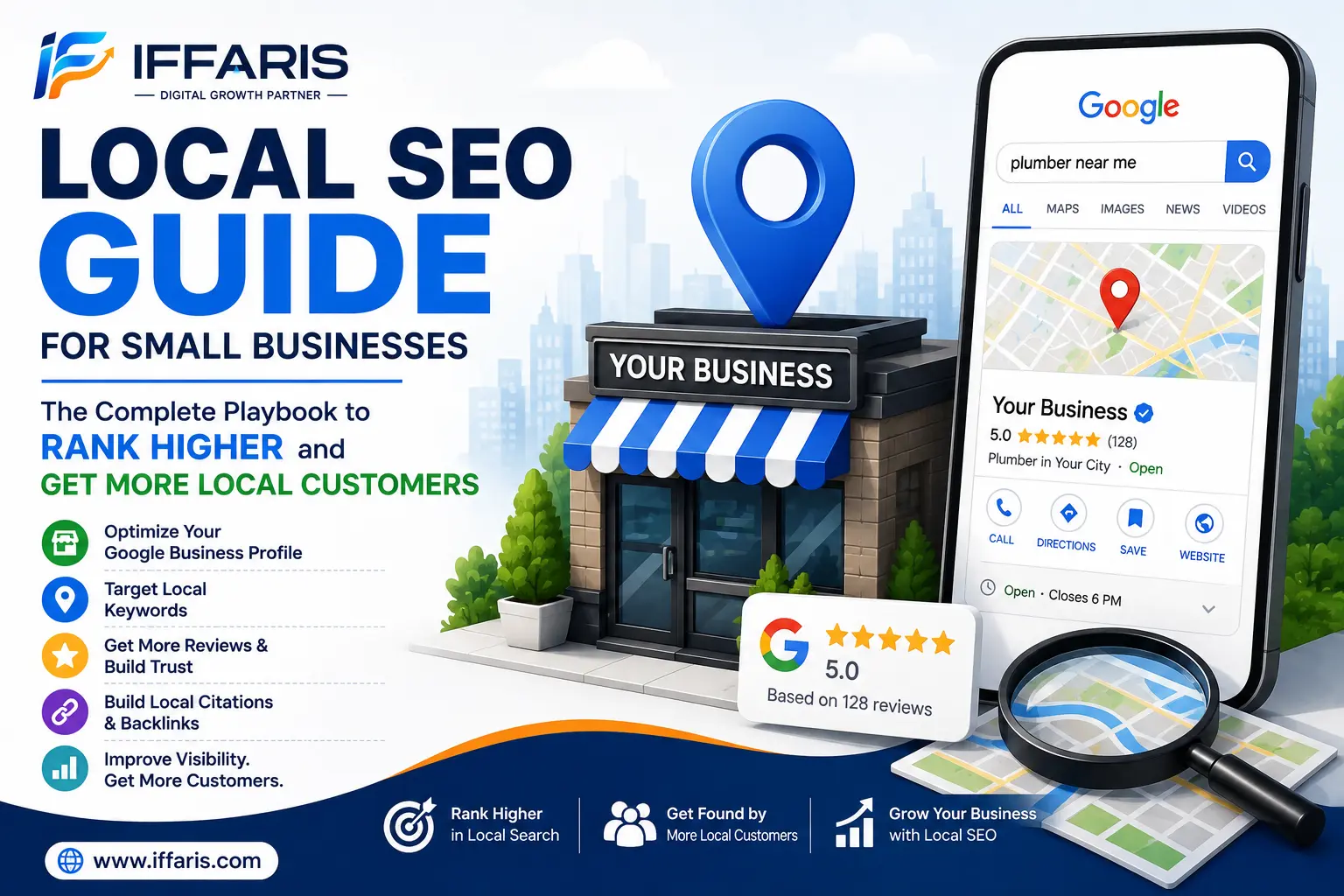
If you run a small business and you are tired of watching competitors show up first on Google while your website sits buried on page two, this local SEO guide is for you. Local search has become the single biggest driver of foot traffic, phone calls, and booked jobs for small businesses, and a solid local SEO guide can be the difference between a business that thrives in its community and one that struggles to get noticed.
In this local SEO guide, we will walk through everything a small business owner needs to know: from setting up and optimizing a Google Business Profile, to building citations, earning reviews, creating locally relevant content, and fixing the technical issues that quietly hold rankings back. Whether you run a plumbing company, a bakery, a law firm, or a boutique gym, this local SEO guide gives you a practical, step-by-step roadmap you can start using today.
What Is Local SEO and Why Does This Local SEO Guide Matter?
Local SEO is the process of optimizing your online presence so that your business appears in search results when people nearby search for the products or services you offer. Unlike traditional SEO, which competes on a national or global scale, local SEO focuses on visibility within a specific city, region, or service area. That is exactly why this local SEO guide exists: most small businesses do not need to outrank giant national brands everywhere in the world, they simply need to dominate search results in their own backyard.
When someone types “electrician near me” or “best coffee shop downtown,” Google pulls together a set of ranking signals — relevance, distance, and prominence — to decide which businesses deserve the top spots, including the coveted Local Pack (the map with three business listings at the top of search results). This local SEO guide is built around improving exactly those three ranking signals so your business consistently appears where customers are looking.
Small businesses that follow a structured local SEO guide typically see several measurable benefits:
- More phone calls and direction requests from Google Business Profile
- Higher click-through rates from local search results
- Increased foot traffic from nearby customers
- Better trust and credibility through reviews and citations
- Lower reliance on paid advertising over time
Step 1: Claim and Fully Optimize Your Google Business Profile
No local SEO guide would be complete without starting at the foundation: your Google Business Profile (formerly Google My Business). This free listing is often the very first thing potential customers see, and it plays an outsized role in whether you appear in the Local Pack.
To get the most from this part of the local SEO guide, make sure you:
- Claim and verify your listing. If you have not verified ownership yet, do this first — an unverified profile carries far less weight in local rankings.
- Choose accurate categories. Select a primary category that precisely matches your core service, then add secondary categories that reflect everything else you offer.
- Write a complete, keyword-aware business description. Describe what you do, who you serve, and where you operate, without stuffing keywords unnaturally.
- Add your service areas. If you travel to customers rather than operating from a storefront, list every city or region you actually serve.
- Upload real photos regularly. Businesses with fresh, authentic photos tend to receive more clicks and calls than those with stock imagery or outdated pictures.
- Use the Q&A and Posts features. Answering questions and publishing updates signals an active, trustworthy business to both users and Google.
A properly optimized Google Business Profile is the single highest-leverage step in any local SEO guide, because it directly feeds the Local Pack, Google Maps, and voice search results.
Step 2: Fix Your NAP Consistency Across the Web
NAP stands for Name, Address, and Phone number, and consistency here is a non-negotiable pillar of every effective local SEO guide. If your business name is listed as “Smith Plumbing LLC” on your website but “Smith Plumbing Co.” on Yelp and “Smith’s Plumbing” on Facebook, search engines struggle to confirm these are the same business, which weakens your local rankings.
A thorough local SEO guide recommends auditing your NAP details across:
- Your website footer and contact page
- Google Business Profile
- Yelp, Facebook, and other social platforms
- Industry-specific directories (HomeAdvisor, Angi, TripAdvisor, etc.)
- Local chamber of commerce listings and niche business directories
Once you identify inconsistencies, correct each listing so every platform shows identical formatting. This single cleanup task, though tedious, is one of the most overlooked recommendations in most local SEO guide checklists — yet it consistently moves the needle for local rankings.
Step 3: Build Local Citations and Directory Listings
Citations are online mentions of your business name, address, and phone number, whether or not they include a link. Building citations on reputable directories is a classic tactic in any local SEO guide, because each consistent citation acts as a trust signal that reinforces your legitimacy to search engines.
Prioritize citations in this order:
- Core data aggregators — these distribute your information to dozens of smaller directories automatically.
- General directories — Yelp, Bing Places, Apple Maps, Facebook.
- Industry-specific directories — relevant to your niche, whether that is home services, legal, medical, or hospitality.
- Local directories — city guides, chamber of commerce websites, and regional business associations.
Following this order keeps your citation-building efforts efficient rather than scattershot, which is why nearly every serious local SEO guide recommends tackling aggregators first.
Step 4: Optimize Your Website for Local Search
Your website itself needs dedicated local SEO guide-style optimization, separate from your Google Business Profile. Search engines crawl your site’s content, structure, and metadata to determine relevance for local queries, so this step cannot be skipped.
On-Page Elements to Optimize
- Title tags and meta descriptions — include your city or service area alongside your primary keyword.
- Header tags (H1, H2, H3) — structure content so both users and search engines can quickly understand what the page covers.
- Location pages — if you serve multiple cities or neighborhoods, create a dedicated page for each one rather than a single generic “service areas” page.
- Embedded Google Map — add an interactive map on your contact page showing your exact location or service radius.
- Schema markup — implement LocalBusiness structured data so search engines can parse your NAP details, hours, and reviews directly from your code.
Once your local pages are structured, the next priority is page-level optimization itself — title tags, headers, content depth, and internal links. Our on-page SEO checklist for local business websites offers a detailed, step-by-step breakdown that pairs well with this local SEO guide, particularly around title tag formulas, image optimization, and fixing duplicate content across multi-location pages.
Content That Supports Local Rankings
Publishing locally relevant blog content is another pillar of a well-rounded local SEO guide. Consider writing about:
- Community events you sponsor or participate in
- Case studies or before-and-after project features tied to specific neighborhoods
- Guides addressing common problems your local customers face
- Seasonal content relevant to your service area’s climate or calendar
This kind of content naturally attracts local backlinks and keeps your site fresh, both of which are ranking factors Google rewards.
Local Keyword Research: Finding the Right Terms to Target
Before writing a single page of content, it helps to understand exactly what your potential customers are typing into search engines. Local keyword research is the process of identifying search terms that combine your services with location modifiers, and it should shape everything from your homepage copy to your blog topics.
Start by brainstorming combinations of:
- Service + City: “roof repair Austin,” “wedding photographer Manchester”
- Service + Neighborhood: “dog groomer downtown,” “tax accountant near [specific district]”
- Service + Near Me: “emergency locksmith near me,” “24 hour towing near me”
- Problem-based searches: “why is my AC not cooling,” “signs I need a new water heater”
Tools such as Google Keyword Planner, Google Search Console, and even Google’s autocomplete and “People also ask” sections can reveal real search phrases your customers already use. Pay close attention to search volume alongside competition — a keyword with modest volume but low competition can often bring in more qualified traffic than a highly competitive term with no realistic chance of ranking in the near term.
Once you have a working list of terms, map them to specific pages on your site. Your homepage might target your broadest service-plus-city term, while individual service pages and location pages target more specific combinations. This structure avoids keyword cannibalization, where multiple pages compete against each other for the same search term instead of reinforcing one another.
Step 5: Earn and Manage Customer Reviews
Reviews are one of the most influential ranking factors covered in any modern local SEO guide, and they are also the factor most directly tied to consumer trust. Google itself has confirmed that review count, review recency, and review score all contribute to local ranking calculations.
A practical review strategy within this local SEO guide includes:
- Asking every satisfied customer for a review, ideally right after a successful job or purchase, when satisfaction is highest.
- Making it easy by sending a direct link to your Google Business Profile review form.
- Responding to every review, positive or negative, professionally and promptly.
- Never buying or faking reviews — Google actively detects and penalizes manipulated review profiles, and the reputational damage if discovered can be severe.
- Highlighting reviews on your website, which builds trust with visitors and can reinforce relevant keywords naturally when customers mention specific services.
Consistent, authentic reviews compound over time, and this is why most local SEO guide strategies treat reputation management as an ongoing task rather than a one-time project.
Step 6: Build Local Backlinks
Backlinks from other websites remain a core ranking factor, and local backlinks in particular carry extra weight for local search visibility. A well-rounded local SEO guide should always include a backlink strategy focused on relevance and locality rather than sheer volume.
Effective ways to build local backlinks include:
- Sponsoring local sports teams, charities, or community events in exchange for a website mention
- Partnering with complementary local businesses for joint content or cross-promotion
- Getting featured in local news outlets or community blogs
- Joining your local chamber of commerce, which often includes a member directory link
- Guest posting on industry blogs that serve your geographic market
If you want to strengthen the technical foundation your content and links are built on, our technical SEO checklist walks through 25+ crawlability, speed, and structured-data checks that make every backlink and page you publish perform better. And if you are still fuzzy on how search engines evaluate any of this in the first place, our beginner-friendly what is SEO guide breaks down the fundamentals this local SEO guide builds on.
Step 7: Fix Technical Issues That Undermine Local Rankings
Technical SEO problems can quietly sabotage even the best-executed local SEO guide strategy. Search engines need to crawl, render, and index your site efficiently, and any friction in that process can suppress your rankings regardless of how strong your content or citations are.
Key technical factors to review:
- Mobile-friendliness — most local searches happen on mobile devices, so a site that is not fully responsive will underperform.
- Page speed and Core Web Vitals — slow-loading pages frustrate users and signal lower quality to search engines.
- Secure HTTPS connection — a basic trust signal that Google has confirmed factors into rankings.
- Clean URL structure — descriptive, readable URLs help both users and crawlers understand page content.
- XML sitemap and robots.txt — make sure these files are correctly configured so search engines can find and index every important page.
- Duplicate content — especially common on multi-location sites where service pages are copy-pasted with only the city name changed; each page needs unique, locally specific content.
Addressing these technical fundamentals ensures the rest of your local SEO guide efforts are not wasted on a site that search engines struggle to crawl properly.
Step 8: Track, Measure, and Adjust
No local SEO guide is complete without a measurement plan. Without tracking, you cannot tell which tactics are working and which need to be dropped or adjusted.
Metrics worth monitoring monthly include:
- Local Pack rankings for your target keywords and service areas
- Google Business Profile insights — views, calls, direction requests, and website clicks
- Organic traffic to location-specific landing pages
- Conversion rate from local search visitors to leads or customers
- Review count and average rating trends over time
Reviewing these metrics regularly lets you refine your local SEO guide approach based on real data rather than guesswork, doubling down on what drives results and cutting what does not.
Local SEO Guide by Business Type
Different types of small businesses need to apply this local SEO guide a little differently, depending on whether they operate from a physical storefront, travel to customers, or serve a mix of both.
Service-area businesses (plumbers, electricians, towing companies, appliance repair technicians) should lean heavily on service-area pages within their Google Business Profile and website, since they may not have a public-facing storefront. This local SEO guide recommends listing every city or neighborhood served, rather than relying on a single generic “areas we cover” page, because dedicated pages give search engines more specific signals to match against local search queries.
Storefront businesses (restaurants, retail shops, salons) benefit most from hyperlocal content, foot-traffic-driving Google Posts, and photo-heavy profiles that showcase the physical experience of visiting. For these businesses, this local SEO guide suggests prioritizing in-store events, local partnerships, and location-specific landing pages if there are multiple branches.
Professional services (law firms, accountants, medical practices) should focus this local SEO guide’s principles on trust signals: detailed bios, credentials, professional certifications, and a steady stream of client reviews, since these industries are judged heavily on credibility before a customer ever reaches out.
Regardless of business type, the core mechanics of this local SEO guide remain the same — a complete profile, consistent citations, strong on-page optimization, and an active reputation management process.
Multi-location businesses face a slightly more complex version of the same playbook. Each physical location needs its own Google Business Profile, its own unique location page on the website, and its own set of localized citations. Resist the temptation to duplicate content across location pages with only the city name swapped out — search engines recognize this pattern quickly, and it can suppress rankings for every location involved rather than just one. Instead, include unique details for each branch: local staff, specific services offered at that location, nearby landmarks, and location-specific customer reviews where possible.
Local SEO Guide FAQs
Do I need a physical address to rank locally? Not necessarily. Service-area businesses without a public storefront can still create a Google Business Profile and hide their exact address while listing their service areas, as this local SEO guide covered in Step 1.
Is local SEO better than paid ads for small businesses? They serve different purposes. Paid ads deliver immediate visibility, while the tactics in this local SEO guide build compounding, long-term organic visibility that continues generating leads without an ongoing ad spend.
How many reviews do I need to rank well? There is no fixed number, but businesses that follow the review strategy outlined in this local SEO guide typically see the biggest ranking gains when they steadily accumulate recent, detailed reviews rather than a large batch all at once.
Can I do local SEO myself, or do I need an agency? Many small business owners successfully implement every step in this local SEO guide on their own, especially the Google Business Profile setup and review requests. Agencies become more valuable when you need help with technical fixes, ongoing content production, or scaling citation building across many locations.
What is the single most important step in this local SEO guide? If you can only do one thing, fully complete and actively maintain your Google Business Profile. It has the most direct impact on whether you appear in the Local Pack, and it feeds into nearly every other tactic covered in this local SEO guide.
Common Local SEO Mistakes Small Businesses Make
Even businesses that follow a local SEO guide can undercut their own progress with avoidable mistakes:
- Ignoring Google Business Profile updates after the initial setup, letting hours, photos, or services go stale
- Inconsistent NAP details scattered across old directory listings
- Thin or duplicated location pages that offer no real value to visitors
- Neglecting mobile experience, despite the majority of local searches happening on phones
- Buying fake reviews, which risks profile suspension and permanent reputational harm
- Treating local SEO as a one-time project instead of an ongoing process that requires regular attention
Avoiding these pitfalls is just as important as following the positive steps outlined earlier in this local SEO guide.
Why These Mistakes Hurt More Than They Seem
It is easy to underestimate how much small inconsistencies compound over time. A single outdated phone number on one directory might not seem significant, but when multiplied across a dozen forgotten listings, it sends conflicting signals to search engines about which details are actually correct. Similarly, a handful of thin, templated location pages might individually seem harmless, but together they can make an entire website look low-effort in the eyes of both users and search algorithms. The businesses that get the most out of local search are rarely the ones with the flashiest websites — they are the ones that consistently avoid these small, compounding errors while steadily executing the fundamentals.
It also helps to assign ownership internally. Many small businesses lose momentum simply because no one is clearly responsible for updating the Google Business Profile, responding to reviews, or publishing new content. Even part-time attention, applied consistently every week, tends to outperform an intense one-time push followed by months of neglect.
How Long Does Local SEO Take to Work?
One of the most common questions small business owners ask when starting with a local SEO guide is how quickly they can expect results. In general, businesses in less competitive niches or smaller markets may see meaningful movement in the Local Pack within a few weeks of completing profile and citation work. More competitive industries and larger cities typically require three to six months of consistent effort — citations, reviews, content, and backlinks — before rankings stabilize at the top.
Patience matters here. A local SEO guide is not a quick fix; it is a compounding strategy where each optimized listing, earned review, and published article adds incremental authority that builds over time.
Several factors influence timeline speed: how established your competitors already are, how many quality citations and reviews you can realistically earn each month, and how consistently you publish locally relevant content. Businesses in brand-new markets with little existing competition sometimes see noticeable movement within the first two to four weeks simply from claiming and optimizing their Google Business Profile. Businesses competing in saturated markets, such as personal injury law or HVAC services in a major metro area, should expect a longer runway and treat the first ninety days as a foundation-building period rather than expecting immediate top rankings.
Local SEO Guide Checklist: Quick Recap
To summarize everything covered in this local SEO guide, here is a condensed checklist you can revisit as you work through your own optimization:
- Claim and fully complete your Google Business Profile
- Audit and fix NAP consistency across every online listing
- Build citations on core directories, starting with major data aggregators
- Optimize your website’s title tags, headers, and location pages
- Add LocalBusiness schema markup to your site
- Publish locally relevant, unique content regularly
- Actively request and respond to customer reviews
- Build local, relevant backlinks through partnerships and sponsorships
- Resolve technical SEO issues, especially mobile speed and duplicate content
- Track rankings and Google Business Profile insights monthly
Final Thoughts on This Local SEO Guide
Ranking locally is not about chasing a single trick or shortcut — it is about consistently executing the fundamentals covered throughout this local SEO guide: a complete Google Business Profile, consistent citations, a technically sound website, genuine reviews, locally relevant content, and a steady stream of local backlinks. Small businesses that commit to this process, even gradually, tend to outperform competitors who treat local search as an afterthought.
If you are just getting started, do not try to tackle every step in this local SEO guide at once. Start with your Google Business Profile and NAP consistency, then move through citations, website optimization, and reviews over the following weeks. Local search rewards consistency far more than perfection, and every improvement compounds toward stronger visibility, more calls, and more customers walking through your door.