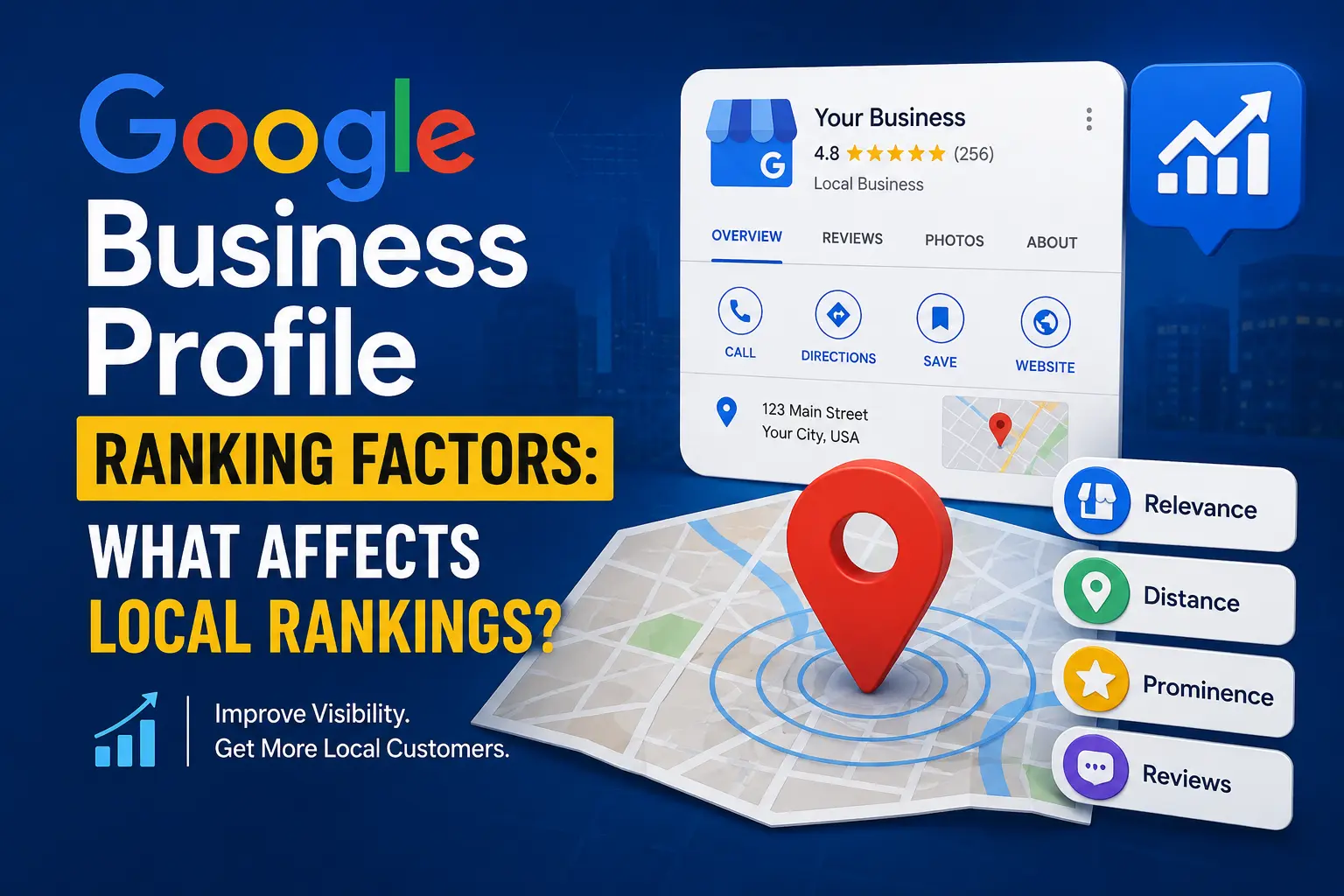
If your business isn’t showing up in the local map pack, the problem almost always comes down to Google Business Profile ranking factors. Local search has quietly become the first place customers look before they call, visit, or buy, and Google decides who appears at the top using a specific mix of signals. Understanding these ranking factors is no longer optional for a local business owner — it’s the difference between being found and being invisible.
Every day, millions of searches include phrases like “near me,” a city name, or a specific service, and Google has to decide instantly which handful of businesses deserve the top three spots in the map pack. That decision isn’t random, and it isn’t based on a single setting inside your dashboard. It’s the result of dozens of individual signals working together, some of which you control directly and some of which are shaped by how customers, other websites, and directories talk about your business online.
This guide breaks down every major group of Google Business Profile ranking factors, explains how each one works, and shows you exactly what to fix first. Whether you run a single storefront or manage locations across a whole city, the same core signals apply, and small, consistent changes tend to move rankings faster than most business owners expect. By the end of this guide, you’ll have a clear, prioritized picture of what actually moves the needle, and what’s simply noise.
What Is a Google Business Profile and Why Ranking Matters
A Google Business Profile (formerly Google My Business) is the free listing that appears in Google Search and Google Maps whenever someone searches for a business like yours nearby. It shows your name, address, phone number, hours, reviews, photos, and posts, all pulled together into one snapshot that customers use to make quick decisions.
Ranking well in the local map pack — the three listings shown at the top of a local search — drives an outsized share of calls, direction requests, and website visits for local businesses. Studies of local search behavior consistently show that the top three map pack results capture the overwhelming majority of clicks, while listings below the fold are rarely seen at all. This “winner takes most” dynamic is exactly why understanding the underlying ranking system matters so much: a small improvement that pushes a business from position five to position two can translate into a meaningful, measurable increase in phone calls and foot traffic within the same month.
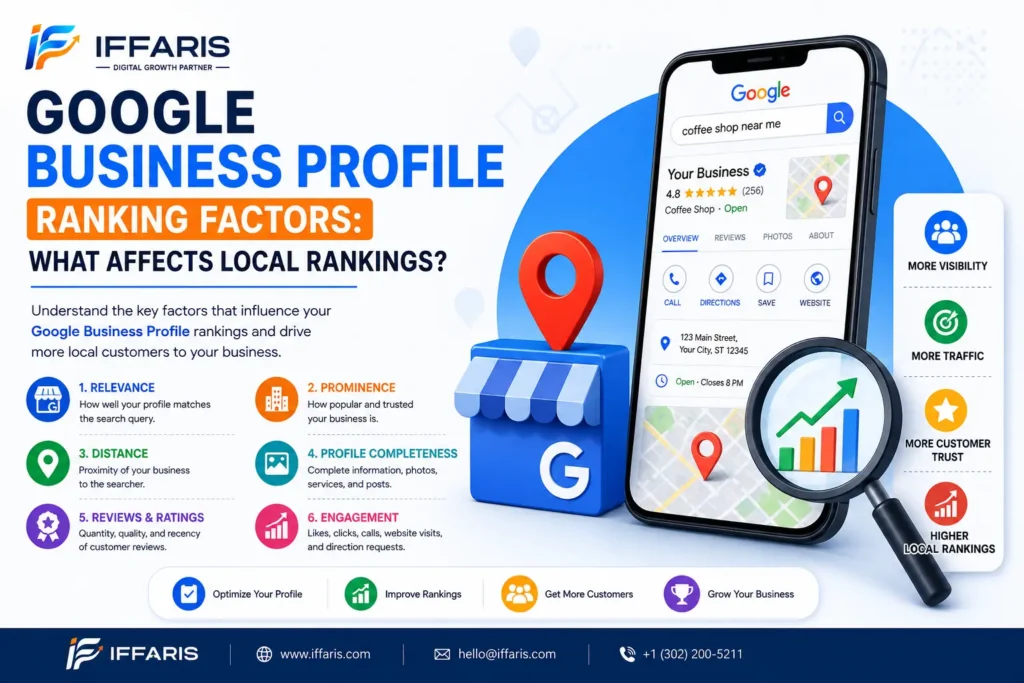
Before diving into individual signals, it helps to understand that Google Business Profile ranking factors are grouped into three broad categories that Google itself acknowledges: relevance, distance, and prominence. Everything else in this guide — from categories and reviews to backlinks and engagement metrics — fits somewhere inside those three buckets. Once you understand which bucket a given tactic belongs to, it becomes much easier to prioritize your time and know what will actually move rankings versus what’s just busywork.
The Three Core Google Business Profile Ranking Factors
Relevance
Relevance measures how well your profile matches what someone is searching for. This is one of the foundational Google Business Profile ranking factors because Google can’t rank a listing it doesn’t understand. A well-optimized profile with accurate categories, a clear business description, and complete service or product listings gives Google the signals it needs to match your business to the right searches.
Relevance also extends to your reviews and posts. If customers repeatedly mention specific services in their reviews, that reinforces relevance for those search terms. This is why encouraging detailed reviews, rather than one-word ratings, plays into local rankings more than most business owners realize. Think of relevance as Google asking a simple question: “does this business actually offer what the searcher is looking for?” Every field you fill out, every photo you caption, and every review you collect is an opportunity to answer that question more clearly.
Distance
Distance is exactly what it sounds like: how far your business is from the location of the person searching, or from the location implied in their search query. This is one of the few ranking signals you can’t directly control, since it depends on where the searcher is physically standing or which city they typed into the search box.
That said, distance interacts with the other Google Business Profile ranking factors. A business with strong relevance and prominence can still outrank a closer competitor with a weak profile, which is why distance alone rarely decides the outcome. This is good news for businesses located slightly outside a city’s core commercial district — a well-optimized, well-reviewed profile can still compete effectively against closer but weaker competitors.
Prominence
Prominence reflects how well-known and well-regarded your business is, both online and offline. This is arguably the most complex of the three Google Business Profile ranking factors because it pulls from dozens of smaller signals: review count, review rating, review recency, backlinks to your website, citations across business directories, news mentions, and general brand authority.
Because prominence is built over time, it’s the factor most tied to consistent, ongoing effort rather than a one-time fix. Businesses that treat their profile as an active marketing channel, rather than a static listing, tend to build prominence faster. A business that has operated in a community for years, sponsors local events, and appears in local press will typically have an easier time ranking than a brand-new business with an identical profile setup, simply because prominence signals accumulate over time.
On-Profile Google Business Profile Ranking Factors
On-profile signals are the elements you control directly inside your Google Business Profile dashboard. These are usually the fastest Google Business Profile ranking factors to improve because they don’t require outside cooperation from customers or other websites.
Business Categories
Your primary category is one of the heaviest-weighted Google Business Profile ranking factors. Choosing the most specific and accurate primary category — rather than a broad, generic one — tells Google exactly what kind of searches your business should appear for. Secondary categories add extra relevance but should never replace a precise primary category.
Business Name
Google explicitly warns against stuffing keywords into your business name, but an accurate, consistent name still functions as one of the Google Business Profile ranking factors that affects both relevance and trust. Keyword-stuffed names can trigger suspensions, which erases any ranking benefit instantly.
NAP Consistency (Name, Address, Phone)
Consistent name, address, and phone number details across your website, your profile, and every directory listing form a trust signal that feeds directly into Google Business Profile ranking factors. Inconsistent NAP data confuses Google’s matching algorithm and can quietly suppress rankings without any obvious warning.
Business Description
The business description gives you room to naturally describe your services, service area, and what makes you different. While it carries less weight than categories, it still contributes to the overall relevance signals among Google Business Profile ranking factors, especially when it reflects the same language customers use to search.
Products and Services Listings
Filling out the Products and Services sections with detailed, keyword-relevant descriptions is an underused lever among Google Business Profile ranking factors. Many business owners skip this section entirely, leaving relevance signals on the table that competitors could be capturing instead.
Photos and Videos
Profiles with regularly updated, high-quality photos tend to perform better across nearly every study of Google Business Profile ranking factors. Photos increase engagement (clicks, calls, and direction requests), and that engagement loops back into prominence, one of the three core Google Business Profile ranking factors discussed earlier.
Google Posts
Regularly publishing Google Posts — updates, offers, and events — signals an active, well-maintained profile. While the direct ranking impact is debated, Posts consistently show up in analyses of Google Business Profile ranking factors because they increase engagement metrics that Google can measure.
Q&A Section
The Questions and Answers section is often ignored, but proactively seeding useful questions and answers adds relevant keywords in a natural way, quietly supporting the relevance side of Google Business Profile ranking factors.
Business Attributes
Attributes like “wheelchair accessible,” “free Wi-Fi,” or “women-owned” help match your profile to filtered searches. These small details are minor Google Business Profile ranking factors individually, but they add up across a fully optimized profile.
Off-Profile Google Business Profile Ranking Factors
Off-profile signals live outside your Google Business Profile dashboard, but they still weigh heavily on Google Business Profile ranking factors because they feed directly into prominence.
Review Quantity and Velocity
The total number of reviews, and how consistently new reviews come in, is one of the most influential Google Business Profile ranking factors. A steady stream of new reviews signals an active, trusted business, while a profile that hasn’t received a review in months can lose ground even with a high overall rating.
Review Rating
Average star rating matters, but it interacts with review quantity. A 4.7-star rating with 300 reviews typically outperforms a 5.0-star rating with 8 reviews, because Google Business Profile ranking factors weigh both the score and the volume of trust behind it.
Review Content and Keywords
Reviews that naturally mention your services, location, or specialty reinforce relevance. Encouraging customers to describe what they had done, rather than leaving generic praise, strengthens this layer of Google Business Profile ranking factors over time.
Review Responses
Responding to reviews — both positive and negative — shows Google (and customers) that the business is active and engaged. This behavioral signal is a smaller but real piece of the Google Business Profile ranking factors puzzle.
Citations and Directory Listings
Consistent listings across directories like Yelp, Apple Maps, Bing Places, and industry-specific directories build the trust and consistency that prominence-related Google Business Profile ranking factors depend on. Duplicate or inconsistent listings can work against you here.
Backlinks to Your Website
Backlinks from reputable local and industry websites don’t just help your website rank — they also feed into the prominence signal among Google Business Profile ranking factors, since Google associates authoritative websites with authoritative businesses. If you want a deeper breakdown of how link building works, our link building guide covers the fundamentals in detail.
Website SEO Signals
Your website’s own on-page SEO, structured data, and overall technical health indirectly support Google Business Profile ranking factors, since Google cross-references your website content to verify relevance. If your technical foundation needs work, our technical SEO checklist is a useful starting point before focusing on profile-level optimization.
Behavioral and Engagement Google Business Profile Ranking Factors
Google increasingly leans on real-world user behavior as part of its Google Business Profile ranking factors, since actual customer actions are a strong proxy for quality.
Click-Through Rate
How often searchers click into your profile compared to competitors shown alongside it feeds back into Google’s ranking model. A compelling primary photo and a strong review snippet both influence this piece of the Google Business Profile ranking factors.
Direction Requests and Calls
Direction requests, phone calls, and website visits generated directly from your profile are tracked and factored into how Google evaluates prominence. These actions are some of the clearest Google Business Profile ranking factors because they represent real intent to do business with you.
Dwell Time on Profile
How long users spend browsing your photos, reviews, and posts before leaving is another behavioral input among Google Business Profile ranking factors. Profiles that give users more to explore tend to hold attention longer, which can support rankings indirectly.
Common Mistakes That Hurt Google Business Profile Ranking Factors
Even businesses that understand Google Business Profile ranking factors in theory often make avoidable mistakes that quietly suppress their rankings.
- Choosing the wrong primary category. This single setting affects more Google Business Profile ranking factors than almost any other field on the profile.
- Ignoring NAP consistency across the web. Mismatched details confuse the trust signals tied to Google Business Profile ranking factors.
- Letting reviews go unanswered. A silent profile looks inactive, which works against the engagement side of Google Business Profile ranking factors.
- Using a virtual office or unqualified address. Address eligibility issues can trigger suspensions that erase all ranking progress overnight.
- Neglecting photo updates. Stale photo galleries reduce the engagement signals that feed prominence-related Google Business Profile ranking factors.
- Skipping the Products and Services sections. This leaves free relevance signals unused, handing an easy advantage to competitors who do fill them out.
- Duplicate listings. Multiple profiles for the same location split reviews and citations, diluting the prominence signals central to Google Business Profile ranking factors.
If you’re building out a broader local SEO strategy, our local SEO guide walks through how Google Business Profile fits into the bigger picture alongside citations, on-page SEO, and content.
A Practical Checklist to Improve Your Google Business Profile Ranking Factors
- Audit your primary and secondary categories against what competitors in the map pack are using.
- Verify NAP consistency across your website, profile, and top directories.
- Fill out every section — description, products, services, and attributes — with natural, relevant language.
- Upload new photos monthly, including team photos, completed work, and the storefront.
- Ask every satisfied customer for a review, ideally with a simple follow-up text or email after service.
- Respond to every review within 48 hours, thanking positive reviewers and addressing negative ones professionally.
- Publish a Google Post at least weekly covering offers, updates, or recent projects.
- Build citations on relevant, reputable directories in your industry and city.
- Earn backlinks from local news sites, partners, and industry associations.
- Track direction requests, calls, and website clicks monthly to see which changes move the needle.
Working through this checklist consistently addresses nearly every category covered in this guide, from relevance and distance to prominence and behavioral engagement. Most business owners find it helpful to tackle the list in order: the first few items are quick wins that can be completed in a single afternoon, while items further down — like citation building and backlink acquisition — are ongoing efforts that pay off gradually over several months.
It also helps to assign clear ownership within your team. If you manage the profile yourself, block out a recurring weekly slot to handle posts, photo uploads, and review responses rather than trying to remember them sporadically in between other tasks. If you work with an agency or a dedicated team member, make sure reporting includes the specific metrics tied to these signals — review count, response rate, post frequency, and citation accuracy — rather than vague summaries that don’t tie back to measurable ranking inputs. Clear accountability tends to be the single biggest predictor of whether a profile actually improves over time or quietly stagnates.
How Long Does It Take to See Ranking Improvements?
Because these signals span both on-profile settings and off-profile trust signals, improvements rarely happen overnight. Category and NAP fixes can shift rankings within a few weeks, while prominence-related Google Business Profile ranking factors — like review volume and backlinks — typically take two to four months of consistent effort to show a measurable impact. Businesses that treat profile optimization as an ongoing task, rather than a one-time setup, see the most durable gains.
It’s also worth setting realistic expectations with anyone involved in the process, whether that’s an in-house marketing hire or an outside agency. Local rankings can fluctuate week to week even without any changes on your end, since Google is constantly re-evaluating every business in a given area. A short-term dip doesn’t necessarily mean something is wrong; what matters is the overall trend over a 90-day window, tracked against consistent metrics like map pack visibility, call volume, and direction requests.
Why Google Business Profile Ranking Factors Differ Across Industries
Not every industry weighs the same signals equally. A restaurant lives and dies by photo quality, review recency, and menu accuracy, while a home services business like an electrician or plumber leans more heavily on service area settings, category precision, and licensing information in the business description. Understanding these Google Business Profile ranking factors in the context of your specific industry helps you prioritize correctly instead of spreading effort evenly across tactics that may not matter as much for your niche.
For emergency or on-demand service businesses — towing, locksmith, appliance repair, and HVAC — response speed and phone engagement carry extra weight, since Google can observe how quickly customers call after viewing the profile. For product-based or appointment-based businesses, the Products and Services sections and booking integrations tend to matter more. Recognizing which of the Google Business Profile ranking factors apply most heavily to your category is the fastest way to avoid wasting time on lower-impact tasks.
Multi-location businesses face an additional layer of complexity. Each location competes on its own set of Google Business Profile ranking factors, which means duplicating effort — optimizing categories, gathering reviews, and building citations — separately for every location rather than assuming one strong profile will lift the others. Franchise owners in particular should resist the temptation to copy-paste descriptions and photos across locations, since near-duplicate content can dilute relevance signals instead of reinforcing them.
How Google Business Profile Ranking Factors Interact With Local SEO as a Whole
It’s worth remembering that a Google Business Profile doesn’t exist in isolation. The same signals that influence organic website rankings — quality content, backlinks, and technical performance — also feed into the broader local search ecosystem your profile sits inside. A business with a strong website but a neglected profile will underperform, and the reverse is just as true: a beautifully optimized profile attached to a slow, thin website will eventually hit a ceiling, because Google increasingly cross-references both when evaluating trust and relevance.
This is why the most effective local SEO strategies treat the profile and the website as two halves of the same system rather than separate projects. Content published on your website that targets the same services and locations featured on your profile reinforces the relevance signals Google is already looking for, creating a compounding effect that’s hard for competitors to replicate with a single channel alone.
Frequently Asked Questions
What are the three main Google Business Profile ranking factors? Relevance, distance, and prominence are the three categories Google uses to evaluate every local listing. Every specific tactic — from categories to reviews to backlinks — fits inside one of these three groups.
Do reviews really affect Google Business Profile ranking factors? Yes. Review quantity, rating, recency, and content are among the most heavily weighted Google Business Profile ranking factors, since they directly signal prominence and trust to Google.
Can I control distance as a ranking factor? Not directly. Distance depends on the searcher’s location, but strong performance across the other Google Business Profile ranking factors can help a business rank well even when it isn’t the closest option.
How often should I update my Google Business Profile? Treat it like an active channel. Weekly posts, monthly photo updates, and prompt review responses keep the engagement signals tied to Google Business Profile ranking factors moving in the right direction.
Does website SEO affect Google Business Profile ranking factors? Indirectly, yes. Google cross-references your website’s content and technical health to confirm relevance, so a well-optimized site supports the same Google Business Profile ranking factors that your profile settings influence directly.
Final Thoughts
Mastering Google Business Profile ranking factors isn’t about gaming the system — it’s about giving Google clear, consistent, trustworthy signals that your business deserves to be seen. Relevance, distance, and prominence work together, and every on-profile setting, review, citation, and backlink either strengthens or weakens that combination.
Start with the fundamentals — accurate categories, consistent NAP data, and a fully completed profile — then layer in ongoing review generation, content posting, and link building. Business owners who consistently manage these signals, rather than setting up their profile once and walking away, are the ones who hold the top spots in the local map pack month after month.
Local search will keep evolving, and Google will keep refining exactly how it weighs each signal. But the underlying logic — reward businesses that are relevant, nearby, and genuinely trusted by their customers — is unlikely to change. Focus your energy on being that kind of business, both online and in real life, and the rankings tend to follow.