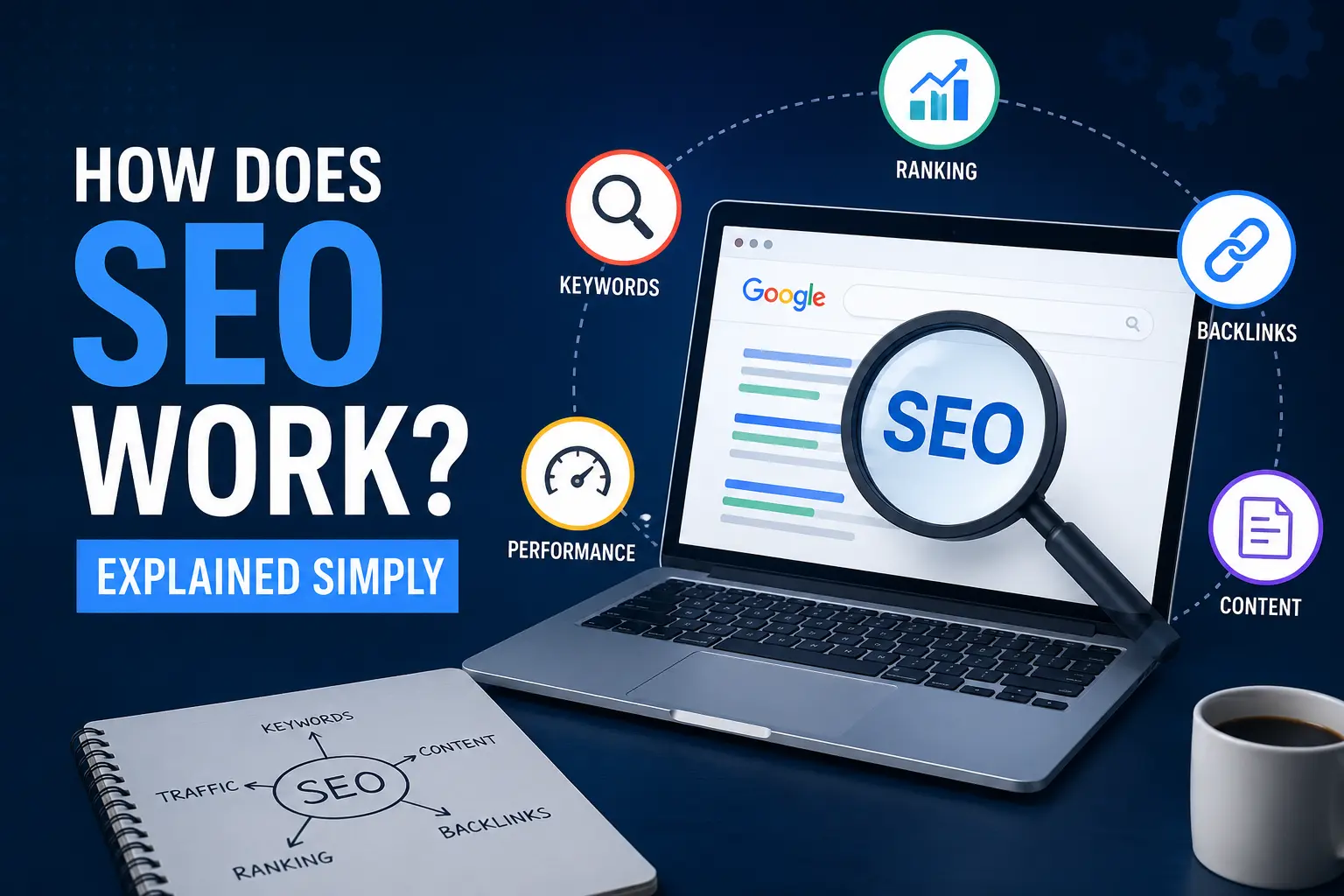
If you have ever typed a question into Google and gotten a perfect answer in under a second, you have already experienced the result of SEO working correctly. But how does SEO work behind that instant answer? Understanding how does SEO work is less about memorizing tricks and more about understanding a system: a search engine finding, understanding, and ranking billions of pages so that the right one shows up for the right person at the right moment.
This guide breaks down how does SEO work in plain language, without the jargon that makes so many beginner guides harder to follow than they need to be. By the end, you will understand not just the theory but the practical steps that actually move a website from page five to page one.
The Short Answer: How Does SEO Work in One Paragraph
Before going deep, here is the short version. Search engines like Google use automated programs called crawlers to discover pages across the internet. Once a page is found, it gets analyzed and stored in a massive database, a process called indexing. When someone searches for something, the search engine scans its index and ranks the most relevant, trustworthy, and useful pages at the top. SEO, or search engine optimization, is the practice of making your website easier to crawl, easier to understand, and more deserving of a top ranking than the competition. That is how does SEO work in a nutshell — everything else in this guide is really just unpacking that one paragraph in more detail.
Step One: Crawling — How Search Engines Find Your Content
The first stage of how does SEO work is discovery. Search engines use bots, often called spiders or crawlers, that travel from link to link across the web, much like a person clicking from page to page. Googlebot is the most well-known example.
Crawlers find new pages primarily through:
- Links from other pages — internal links on your own site and backlinks from external sites.
- XML sitemaps — a file you submit that lists the URLs you want search engines to know about.
- Direct submission — manually requesting indexing through tools like Google Search Console.
If a page has no links pointing to it and is not included in a sitemap, a crawler may never find it at all. This is one of the most overlooked parts of how does SEO work: a page that is never discovered can never rank, no matter how well it is written.
Step Two: Indexing — How Search Engines Understand Your Content
Once a page is crawled, the search engine has to decide whether to store it in the index, which is essentially a giant, searchable library of web pages. This is the second core piece of how does SEO work, and it is where a lot of technical SEO effort is spent.
During indexing, search engines analyze:
- The words and topics on the page
- The structure of the content (headings, lists, images, and how they are organized)
- Signals like page speed, mobile-friendliness, and whether the page is secure (HTTPS)
- Directives you set, such as noindex tags or canonical tags, which explicitly tell search engines what to do
Not every crawled page gets indexed. Thin, duplicate, or low-value pages are often skipped, which is why understanding how does SEO work at the indexing stage matters just as much as getting crawled in the first place. A page can be perfectly discoverable and still miss out on ranking if it never earns a spot in the index.
Step Three: Ranking — How Search Engines Decide the Order
This is the stage most people think of when they ask how does SEO work, because ranking is what determines whether your page shows up on position one or position fifty. Google uses hundreds of ranking factors, but they generally fall into a few major categories.
Relevance
Does the page actually answer the search query? Search engines analyze the words on the page, the topics covered, and how well the content matches the intent behind a search. This is the foundation of how does SEO work at the content level — you cannot rank for a topic your page does not genuinely address.
Authority
Does the wider internet trust this page? Backlinks from other reputable websites act as votes of confidence. A page with many quality backlinks generally signals to search engines that the content is worth trusting, which is a major part of how does SEO work beyond your own website.
User Experience
Does the page load quickly? Is it easy to use on a phone? Do visitors stay and read, or bounce back to the search results immediately? These behavioral and technical signals all feed into how does SEO work in the ranking algorithm, because search engines want to send people to pages that actually satisfy them.
Freshness and Depth
For some topics, especially fast-moving ones like news or technology, how recently a page was updated matters. For others, depth and comprehensiveness matter more than recency. Search engines weigh this differently depending on the query, which is part of why how does SEO work can feel inconsistent if you only study one type of content.
On-Page SEO: The Part You Control Directly
On-page SEO refers to everything you can optimize directly on your own website. This is usually the easiest entry point for beginners trying to understand how does SEO work, because you have full control over it.
Core on-page elements include:
- Title tags — the clickable headline shown in search results.
- Meta descriptions — the short summary beneath the title tag.
- Header tags (H1, H2, H3) — used to organize content logically for both readers and search engines.
- Keyword usage — naturally incorporating the terms your audience searches for, without stuffing them in unnaturally.
- Internal linking — connecting related pages on your own site to help both users and search engines navigate your content.
- Image optimization — using descriptive file names and alt text.
Getting these basics right is often the fastest way to see improvement, because it directly addresses the relevance piece of how does SEO work without requiring outside help from other websites.
Off-Page SEO: Building Trust Beyond Your Website
Off-page SEO covers everything that happens away from your website but still influences your rankings. Backlinks are the most well-known example, but off-page SEO also includes brand mentions, social signals, and reviews.
Understanding how does SEO work off-page comes down to one idea: search engines are trying to figure out whether other people, and other trustworthy websites, vouch for your content. A single link from a respected, relevant website often carries more weight than dozens of low-quality links, which is why link building strategy matters as much as link building volume.
Technical SEO: Making Sure Search Engines Can Do Their Job
Technical SEO is the plumbing behind everything else. It does not directly persuade a search engine that your content is great, but it removes the obstacles that would otherwise prevent your content from being evaluated fairly at all. This is a foundational layer in how does SEO work that beginners often skip past, even though ignoring it can quietly cap your entire site’s performance.
Key technical SEO elements include:
- Site speed — slow-loading pages frustrate users and can hold back rankings.
- Mobile-friendliness — most searches now happen on phones, so mobile usability is essential.
- Secure connections (HTTPS) — a baseline trust signal for both users and search engines.
- Clean site architecture — a logical structure that makes it easy for both crawlers and visitors to find important pages.
- Structured data — code that helps search engines understand specific details about your content, like recipes, reviews, or events.
If you want a deeper look at how these technical pieces show up in practice, especially when something breaks, our detailed walkthrough of technical crawl and indexing issues covers the diagnostic side of how does SEO work in more depth than this beginner overview can.
Why How Does SEO Work Differently for Local Businesses
For businesses that serve a specific city or region, how does SEO work shifts slightly to include local-specific signals: your Google Business Profile, consistent business information across directories, local reviews, and location-relevant content. A plumber in Dallas is not competing for the same search results as a plumber in Miami, so local relevance becomes just as important as general authority.
This local layer is a great example of how does SEO work adapting to context. The same core principles of crawling, indexing, and ranking still apply, but the ranking factors that matter most shift depending on whether someone is searching for a national brand or a nearby service provider. If you run a local service business and want to see these principles applied directly, this breakdown of local SEO for trade businesses is a useful next read.
Common Misconceptions About How SEO Works
A lot of confusion around how does SEO work comes from outdated advice still circulating online. A few corrections are worth making clear:
- “Keyword stuffing helps you rank.” It does not. Modern search engines penalize unnatural keyword repetition rather than rewarding it.
- “SEO is a one-time task.” In reality, how does SEO work is an ongoing process, since competitors publish new content, algorithms update, and user behavior shifts over time.
- “More backlinks always means better rankings.” Quality and relevance matter far more than raw quantity when it comes to link building.
- “Meta keywords still matter.” This tag was deprecated by major search engines years ago and has no bearing on how does SEO work today.
How Long Does SEO Take to Work?
One of the most common follow-up questions to how does SEO work is how long results actually take. The honest answer is that meaningful movement usually takes a few months, not days, because search engines need time to crawl new content, evaluate trust signals, and compare your pages against competitors. Highly competitive industries can take even longer, while niche, low-competition topics can sometimes see faster results.
This timeline is a direct consequence of how does SEO work as a trust-building process rather than a paid placement. There is no way to instantly buy your way to the top of organic results, which is exactly what separates SEO from paid advertising.
SEO vs. Paid Search: A Quick Comparison
It helps to clarify how does SEO work compared to paid search, since the two are often confused. Paid search (like Google Ads) lets you pay for immediate visibility at the top of search results, marked clearly as an ad. The moment you stop paying, that visibility disappears. Organic SEO, by contrast, is earned rather than rented — once a page ranks well, it can continue generating traffic without an ongoing cost per click, though it typically takes longer to build that position in the first place.
Most successful digital strategies use both: paid search for immediate visibility while SEO efforts build up in the background, since fully understanding how does SEO work as a long-term investment changes how you budget your marketing time and money.
A Simple Checklist for Getting Started
If you are putting the theory of how does SEO work into practice for the first time, start with these fundamentals:
- Research your keywords. Understand what your audience is actually searching for before you write anything.
- Create genuinely useful content. Answer the question behind the search, not just the words in it.
- Optimize your on-page elements. Titles, headers, and meta descriptions should be clear and relevant.
- Fix technical issues. Confirm your site is fast, mobile-friendly, and free of major crawl errors.
- Build genuine backlinks. Earn links through outreach, partnerships, and content worth referencing.
- Monitor your progress. Use tools like Google Search Console and Google Analytics to see what is working.
A Brief Look at How Search Engines Have Evolved
It helps to understand a little history to fully grasp how does SEO work today. In the early days of the internet, search engines relied heavily on simple keyword matching — if a page repeated your search term enough times, it would rank, regardless of quality. This led to widespread keyword stuffing and low-value content dominating search results.
Over the following two decades, search engines introduced increasingly sophisticated ways to evaluate quality, trust, and relevance. Link analysis taught search engines to treat backlinks as votes of confidence. Later updates introduced natural language understanding, allowing search engines to interpret the meaning behind a query rather than just matching exact words. More recent developments have focused on understanding user intent, page experience, and even the expertise and trustworthiness of the person or organization behind the content.
This evolution matters because it explains why so much outdated SEO advice still floating around no longer works. The fundamentals of how search engines operate have stayed consistent — find, understand, rank — but the sophistication behind each step has increased dramatically, rewarding genuine quality over manipulation.
How Different Content Types Get Evaluated
Text-based blog posts and articles are the most commonly discussed example, but search engines evaluate other content formats too, each with its own nuances.
Images are indexed separately in Google Images and can drive meaningful traffic on their own. Descriptive file names, compressed file sizes, and accurate alt text all help images get discovered and ranked appropriately.
Video content is increasingly prioritized in search results, particularly for how-to and tutorial-style queries. Platforms like YouTube function as their own search engines, with ranking factors that overlap with, but are not identical to, standard web search.
Local listings, such as Google Business Profiles, are evaluated using a mix of traditional relevance signals and location-based proximity, which is why a strong website alone is not always enough for businesses competing in local search.
Voice search results, delivered through smart speakers and voice assistants, tend to favor concise, direct answers pulled from well-structured content, often the same content that already ranks well for featured snippets in traditional search.
Each of these formats still follows the same underlying discovery, evaluation, and ranking logic covered earlier in this guide, just applied through a slightly different lens depending on the platform.
Measuring Whether Your SEO Efforts Are Actually Working
Understanding the theory only matters if you can tell whether your efforts are paying off. A handful of core metrics give a clear picture of progress:
- Organic traffic — the number of visitors arriving from unpaid search results, typically tracked in Google Analytics.
- Keyword rankings — where your target pages appear in search results for specific terms, tracked with tools like Google Search Console or third-party rank trackers.
- Click-through rate — the percentage of people who click your listing after seeing it in search results, which reflects how compelling your title and description are.
- Bounce rate and time on page — indicators of whether visitors find what they were looking for once they arrive.
- Conversions — the ultimate measure of success, whether that means purchases, form submissions, or phone calls generated from organic visitors.
Tracking these metrics consistently, rather than checking once and forgetting, is what turns SEO from a guessing game into a repeatable process you can actually improve over time.
Staying Current as Algorithms Change
Search engines update their ranking algorithms constantly, and major updates can shift rankings noticeably overnight. This does not mean the fundamentals covered in this guide become obsolete; it means the weighting between factors shifts as search engines get better at identifying genuine quality versus manipulation.
A practical approach is to focus most of your energy on the fundamentals — genuinely useful content, technical health, and earned trust — since these remain valuable across nearly every update. Chasing short-term tricks tends to produce short-term results at best, and can actively hurt a site once an update specifically targets that tactic.
Building an SEO Content Strategy That Actually Scales
Understanding how does SEO work at the individual page level is a good start, but most successful websites think in terms of a broader content strategy rather than isolated posts, since a single strong article rarely moves the needle on its own the way a well-structured cluster of related content does. This usually starts with keyword research grouped into themes, often called topic clusters, where one comprehensive “pillar” page covers a broad topic and several supporting articles dive into related subtopics, all linked together.
This structure reinforces how does SEO work in two ways at once. First, it helps search engines understand the relationship between your pages, since internal links signal which content is most important and how topics connect. Second, it helps establish topical authority — search engines tend to trust sites that cover a subject comprehensively over sites that publish scattered, disconnected content on unrelated topics.
A practical way to start is to list every question your audience commonly asks about your core service or product, group those questions by theme, and build content around each group rather than treating every article as a standalone piece competing for attention on its own.
Common Beginner Mistakes to Avoid
Even with a solid grasp of how does SEO work in theory, a few practical mistakes trip up beginners more than anything else:
- Publishing content without keyword research. Writing what you assume people search for, rather than validating it with actual search data, wastes significant effort.
- Ignoring page speed. A beautifully written article on a slow-loading page still loses visitors before they finish reading the first paragraph.
- Neglecting mobile users. With most searches happening on phones, a site that only looks good on desktop is fighting with one hand tied behind its back.
- Expecting instant results. As covered earlier, SEO is a gradual process, and expecting first-page rankings within days leads to premature strategy changes that undo genuine progress.
- Copying competitors word-for-word. Duplicate or near-duplicate content rarely outranks the original and can create indexing problems of its own.
Avoiding these pitfalls will not guarantee top rankings on their own, but it removes the self-inflicted obstacles that slow down otherwise solid SEO work.
Frequently Asked Questions
How does SEO work if I never touch code? Most on-page and content improvements do not require coding knowledge. Many platforms, like WordPress, offer plugins that handle technical details for you.
Does social media affect how does SEO work? Social signals are not a direct ranking factor, but social visibility can lead to more backlinks and brand searches, which do influence rankings indirectly.
Can I understand how does SEO work without hiring an agency? Yes. The fundamentals covered in this guide are enough to start improving a website’s visibility, though larger or highly competitive sites often benefit from specialized help.
Is how does SEO work the same for every search engine? The core principles of crawling, indexing, and ranking are similar across search engines, but the specific algorithms and weighting differ, so a strategy optimized purely for Google may need adjustments for others.
What is the single biggest factor in how does SEO work today? There is no single factor, but relevance combined with genuine trustworthiness consistently outperforms shortcuts and tricks.
Bringing It All Together
Reading through crawling, indexing, ranking, on-page work, off-page trust, and technical health all at once can feel like a lot, but the pieces fit together more simply than they first appear. Every improvement you make ultimately serves one of two goals: helping search engines access and understand your content, or convincing them your content deserves to be trusted above the alternatives. Almost every SEO tactic, no matter how specific it sounds, traces back to one of those two goals.
That framing is useful whenever you feel overwhelmed by a new tactic or tool. Before adopting it, ask which of the two goals it actually serves. If the answer is not clear, it is probably not worth prioritizing over the fundamentals already covered in this guide. Understanding how does SEO work at this level gives you a filter for evaluating new advice for years, long after any single algorithm update or trend has faded.
Final Thoughts
At its core, how does SEO work comes down to three repeating steps: search engines crawl the web to find content, index the pages worth storing, and rank them based on relevance, authority, and user experience. Everything else — keyword research, technical fixes, content strategy, link building — exists to influence one of those three stages.
The businesses and creators who succeed with SEO long-term are not the ones chasing shortcuts. They are the ones who understand how does SEO work as an ongoing relationship between useful content and a search engine trying to serve its users well. Master that relationship, and rankings tend to follow.