Search engine optimization has changed faster in the last three years than it did in the previous decade, and the biggest reason is the rise of AI SEO tools. If you are still relying on spreadsheets, manual audits, and guesswork to plan your content strategy, you are already behind competitors who have adopted this technology to speed up research, writing, and technical fixes. In 2026, these platforms are no longer a “nice to have” add-on for enterprise marketing teams — they have become the backbone of nearly every serious SEO workflow, from solo bloggers to large agencies managing dozens of client accounts.
This guide breaks down exactly what AI SEO tools are, why they matter this year, and which platforms are genuinely worth your budget. We will also cover how to choose the right software for your niche, what it typically costs, common mistakes teams make when adopting it, and where this category is headed next. By the end of this article, you will have a clear roadmap for using this software to grow organic traffic without wasting time on tactics that no longer work.
If you’re new to the fundamentals of ranking on Google, it helps to first understand how search engines actually work before layering this technology on top of your strategy. A solid foundation makes every recommendation this software gives you far easier to interpret and act on.
What Are AI SEO Tools?
AI SEO tools are software platforms that use machine learning, natural language processing, and predictive analytics to automate or accelerate search engine optimization tasks. Instead of manually digging through spreadsheets of keyword data, this software can analyze search intent, competitor content, and ranking factors within seconds. These platforms typically fall into a few broad categories:
- Keyword research tools that surface topic clusters and search intent
- Content generation and optimization software that helps draft and refine articles
- Technical SEO crawlers that scan a site and flag issues automatically
- Link building platforms that identify outreach opportunities
- Rank tracking and analytics dashboards that forecast performance trends
What separates modern AI SEO tools from older rule-based software is their ability to learn from massive datasets and adapt recommendations based on real search engine behavior, rather than static checklists. This is why so many marketers have shifted their budgets toward this category of software in the past two years, and why agencies now list AI proficiency as a hiring requirement for SEO specialists.
For a broader look at how artificial intelligence is reshaping the industry as a whole, check out this deep dive on AI and SEO, which covers the bigger picture beyond individual products.
Why AI SEO Tools Matter in 2026
Search engines themselves now rely heavily on AI models to interpret content and rank pages, so it makes sense that the software used to optimize for those engines has evolved too. Here’s why AI SEO tools have become essential this year rather than optional.
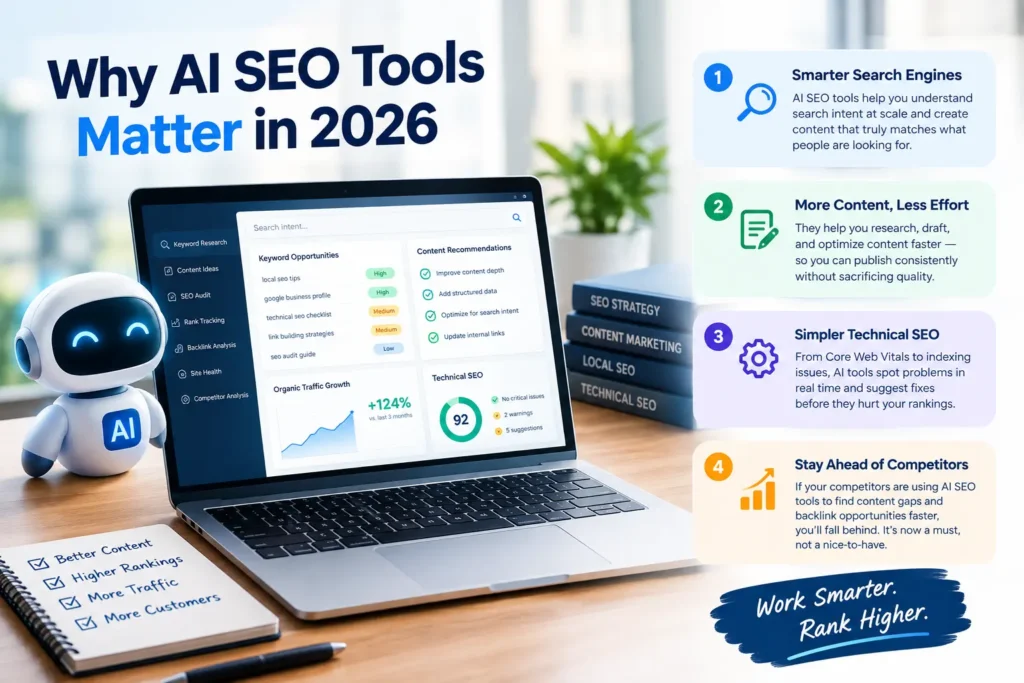
1. Search Engines Have Gotten Smarter
Google’s algorithms increasingly reward content that demonstrates genuine expertise and satisfies search intent rather than simply matching keywords. AI SEO tools help writers and strategists understand intent at scale, something that would take a human analyst hours to do manually for even a single topic cluster. This shift toward intent-matching is one of the main reasons the category has grown so quickly.
2. Content Volume Expectations Have Increased
Competing in most niches today requires publishing consistently and at scale. This software makes it possible to research, draft, and optimize dozens of articles per month without sacrificing quality, provided they are used correctly and not as a shortcut to avoid human review. Teams that skip this balance often end up with thin, generic content that fails to rank despite heavy investment in software.
3. Technical SEO Has Grown More Complex
Core Web Vitals, structured data, crawl budget, and indexing issues all require constant monitoring. AI SEO tools can now detect anomalies in real time and even suggest fixes automatically, saving technical teams countless hours compared with manual audits of large websites containing thousands of pages.
4. Competitive Pressure
If your competitors are using this technology to identify content gaps and backlink opportunities faster than you are, they will simply outpace you in the search results. Adopting this technology is increasingly a matter of staying competitive rather than gaining a novel advantage, much like adopting analytics software was a decade ago.
How AI SEO Tools Actually Work
Most AI SEO tools are built on large language models combined with proprietary SEO datasets pulled from search engine results pages, backlink indexes, and on-site analytics. Here’s a simplified breakdown of the process:
- Data collection – The platform crawls websites, search results, and third-party databases to gather raw information.
- Pattern recognition – Machine learning models identify patterns between ranking pages, such as content structure, keyword usage, and backlink profiles.
- Recommendation generation – The software translates those patterns into actionable suggestions, like which keywords to target or which internal links to add.
- Continuous learning – As search results shift, the best platforms retrain their models to keep recommendations current and relevant.
Understanding this process helps you evaluate whether a given product is genuinely using machine learning or simply repackaging old-school SEO rules with an AI label attached for marketing purposes. Not every tool marketed as an AI SEO tool delivers real automation, so due diligence matters before you commit budget to a subscription.
The Best AI SEO Tools in 2026 (By Category)
Below is a breakdown of the best options available this year, organized by the job each one does best. No single platform does everything perfectly, so most serious marketers combine two or three tools from different categories to cover their entire workflow.
Best AI SEO Tools for Keyword Research
Keyword research is where AI SEO tools first proved their value. Modern platforms in this category go beyond raw search volume and now map out entire topic clusters based on real user intent, seasonality, and competitor positioning.
- Semrush AI toolkit – One of the most established platforms, offering keyword clustering, content gap analysis, and AI-assisted briefs for writers.
- Ahrefs AI features – Known primarily as a backlink database, Ahrefs has added AI-driven content and keyword suggestions that rival tools built solely for this purpose.
- Surfer SEO – A favorite among content teams, this platform blends keyword data with on-page optimization scoring, making it one of the more practical options for writers who need real-time feedback.
If you want a refresher on structuring your findings once you’ve picked your keywords, this on-page SEO checklist pairs well with any keyword research workflow you build around this software.
Best AI SEO Tools for Content Creation and Optimization
Content-focused AI SEO tools help teams go from a blank page to a publish-ready draft much faster, while still leaving room for human editing and fact-checking before anything goes live.
- Jasper AI – Popular for long-form drafting, Jasper integrates with SEO data providers so its output aligns with what is already ranking for a given query.
- Frase.io – Built specifically as an SEO content tool, Frase analyzes top-ranking pages and generates outlines, making it one of the more targeted platforms for bloggers and content marketers.
- Clearscope – Focuses on content grading against target keywords, helping writers avoid both underoptimization and keyword stuffing in the same draft.
These platforms are especially useful for teams that publish frequently but lack the bandwidth to manually research every competing article before writing a single word.
Best AI SEO Tools for Technical SEO Audits
Technical issues can silently tank rankings, which is why this software category has grown so quickly among both enterprise and mid-size site owners.
- Screaming Frog with AI add-ons – A long-time favorite crawler that has integrated AI-based anomaly detection for large, complex sites.
- Sitebulb – Combines visual crawl reports with AI-prioritized issue lists, helping technical teams fix what matters most first instead of chasing minor warnings.
- ContentKing (Conductor) – Offers real-time monitoring, alerting you the moment a technical issue appears rather than waiting for a scheduled audit cycle.
Pairing these AI SEO tools with a manual review process is smart, especially for critical fixes on high-traffic pages. You can cross-reference results against this technical SEO checklist to make sure nothing slips through the cracks.
Best AI SEO Tools for Link Building
Link building remains one of the hardest parts of SEO to scale, but this category of software has made prospecting and outreach considerably more efficient over the last few years.
- Pitchbox – Automates outreach sequences while using AI to personalize messaging at scale across large prospect lists.
- Respona – Combines content research with automated email finding, positioning itself as an all-in-one option for digital PR teams.
- BuzzStream with AI enrichment – Helps manage relationships and track outreach campaigns with AI-assisted prioritization of high-value prospects.
For a strategic overview before diving into any tool, this guide on link building strategies is a useful starting point, and this resource on broken link building pairs particularly well with automated prospecting software.
Best AI SEO Tools for Local SEO
Local businesses have unique needs, and several platforms now specialize specifically in this space.
- BrightLocal – Uses AI to track local rankings across multiple locations and flag citation inconsistencies automatically.
- Whitespark – Focuses on citation building with AI-assisted opportunity discovery across directories.
- GatherUp – Automates review generation and monitoring, an increasingly important ranking factor for local businesses competing in map packs.
If local search is a priority, it’s worth reviewing this local SEO guide alongside whichever platform you choose, since strategy still needs to come before automation.
Best AI SEO Tools for Rank Tracking and Analytics
- Rank Ranger (Similarweb) – Offers AI-forecasted ranking trends rather than just historical snapshots of past performance.
- AccuRanker – Known for speed and accuracy, with AI-based share-of-voice calculations across multiple markets.
- SE Ranking – A budget-friendly option that bundles rank tracking with several other AI SEO tools in one dashboard, which suits smaller teams well.
How to Choose the Right AI SEO Tools for Your Business
With so many options on the market, picking the right software can feel overwhelming, especially for teams evaluating this kind of software for the first time. Here’s a practical framework to narrow things down.
Define Your Biggest Bottleneck First
Are you struggling with keyword research, content production, technical issues, or backlinks? Choosing this software without identifying your actual bottleneck often leads to wasted subscriptions and duplicated features across your stack.
Check for Real Search Console and Analytics Integration
The best AI SEO tools connect directly with Google Search Console and analytics platforms so recommendations are based on your actual performance data, not generic industry benchmarks pulled from unrelated sites. If you’re unfamiliar with this data source, this walkthrough on how to use Google Search Console is a good primer before evaluating any tool’s integration claims.
Evaluate the Learning Curve
Some platforms are built for beginners with simple dashboards, while others require deep SEO expertise to interpret correctly. Choose software that matches your team’s current skill level, or budget time and money for proper training.
Consider Total Cost of Ownership
Many AI SEO tools charge per seat or per project, and costs can add up quickly once you stack multiple platforms across departments. Calculate the realistic monthly cost of everything you’re considering before committing to annual contracts that lock you in.
Test Before You Commit
Nearly every reputable provider in this space offers a free trial or demo. Run a real project through the trial period rather than just exploring the interface, so you can judge output quality firsthand before your team depends on this software daily.
AI SEO Tools vs. Traditional SEO Tools
It’s worth clarifying that AI SEO tools are not a complete replacement for traditional SEO software — in many cases, they are traditional tools with AI layered on top of an existing feature set. The key differences include:
| Feature | Traditional SEO Tools | AI SEO Tools |
|---|---|---|
| Keyword suggestions | Based on static databases | Based on intent analysis and clustering |
| Content guidance | Manual checklists | Automated scoring and drafting |
| Technical audits | Scheduled crawls | Real-time anomaly detection |
| Reporting | Historical data only | Predictive trend forecasting |
| Onboarding | Often manual setup | Guided, template-driven setup |
While these platforms offer clear speed advantages, human judgment is still necessary to verify accuracy, maintain brand voice, and avoid over-reliance on automated output that hasn’t been fact-checked by an experienced editor.

What AI SEO Tools Typically Cost
Pricing varies widely depending on the category and scale of the software. Entry-level keyword research platforms often start around $30 to $50 per month for solo users, while enterprise-grade suites combining content, technical audits, and rank tracking can run into the thousands per month for agencies managing multiple client accounts. Most providers of AI SEO tools offer tiered pricing based on the number of keywords tracked, projects managed, or seats included, so it pays to map your actual usage before choosing a plan rather than assuming the highest tier is necessary.
A practical approach is to start with one platform that solves your single biggest bottleneck, prove ROI over a full quarter, and only then expand your stack. Teams that purchase five different subscriptions on day one often end up using a fraction of the available features, wasting significant budget on overlapping functionality instead of getting real value from their software investment.
Best Practices When Using AI SEO Tools
Adopting this software without a strategy behind it can actually hurt your rankings rather than help them. Follow these best practices to get the most value from your investment.
- Always fact-check AI-generated content. Automated drafting software can occasionally produce inaccurate claims, so editorial review remains essential before publishing.
- Avoid keyword stuffing. Even though many of these platforms optimize for keyword usage, over-relying on their density suggestions can produce spam-like content that reads poorly to real visitors.
- Combine multiple platforms rather than relying on one. No single AI SEO tool excels at every task, so a layered stack usually performs better than a single all-in-one subscription.
- Keep humans in the editing loop. The best results come from using this software to accelerate drafts, not to publish content without review from a subject matter expert.
- Monitor performance after implementation. Track whether changes suggested by your software actually move rankings, rather than assuming every recommendation works equally well for your specific niche.
- Document what works for your niche. Keep an internal log of which suggestions from these platforms produced measurable ranking improvements versus which ones had no impact at all.
Common Mistakes Businesses Make With AI SEO Tools
- Treating this software as a magic bullet. No platform can replace a coherent content and link building strategy built around real audience needs.
- Publishing unedited AI content at scale. Search engines have gotten better at detecting low-effort, unedited AI output, which can hurt rankings rather than help them.
- Ignoring technical fundamentals. Even the smartest AI SEO tools can’t fix a slow, poorly structured website on their own without developer involvement.
- Failing to customize recommendations. Generic suggestions from this software need to be adapted to your brand voice and audience rather than published verbatim.
- Overspending on redundant subscriptions. Many teams pay for multiple AI SEO tools with overlapping features instead of consolidating their stack into one lean toolkit.
- Skipping onboarding entirely. Jumping straight into daily use of new software without proper setup often produces misleading recommendations based on incomplete data.
The Future of AI SEO Tools
Looking ahead, this software category is likely to become even more integrated with search engines themselves, potentially offering direct feedback loops between content changes and ranking impact. We can also expect several notable shifts over the next few years:
- Deeper personalization – Future platforms will adapt recommendations based on your specific industry and historical performance data rather than generic benchmarks.
- Voice and multimodal search optimization – As search expands beyond text, this software will need to account for video, voice, and image search behavior across platforms.
- Tighter integration with content management systems – Expect AI SEO tools to work directly inside your CMS, offering real-time suggestions as you write rather than in a separate dashboard.
- More transparency around AI content detection – As search engines refine how they treat AI-assisted content, the best platforms in this category will help ensure compliance with evolving guidelines.
Marketers who stay current with these shifts and continue refining how they use AI SEO tools will maintain a real advantage over those who adopt the technology passively and never revisit their workflow.
Frequently Asked Questions
Are AI SEO tools worth the investment for small businesses? Yes, many AI SEO tools offer affordable tiers designed for small teams, and the time savings on keyword research and content drafting often justify the cost even on a limited budget.
Can AI SEO tools completely replace an SEO specialist? No. These platforms are best used to support human strategists, not replace them entirely. Judgment, brand context, and quality control still require human oversight at every stage.
Do AI SEO tools guarantee higher rankings? No platform can guarantee rankings, since search engines weigh hundreds of factors simultaneously. AI SEO tools improve efficiency and decision-making, but results still depend on execution and competition in your specific niche.
Which AI SEO tools are best for beginners? Platforms like Surfer SEO and SE Ranking tend to have gentler learning curves, making them good starting points for teams new to this category of software.
How many AI SEO tools should a small team use at once? Most small teams do well with two to three platforms covering keyword research, content optimization, and rank tracking, rather than trying to adopt an entire software suite all at once.
Conclusion
AI SEO tools have moved from an experimental trend to a core part of how modern websites compete for visibility. Whether you need help with keyword research, content creation, technical audits, or link building, there is likely a platform built specifically for that task in 2026. The key to success isn’t picking the single “best” tool — it’s building a stack of AI SEO tools that fit your team’s workflow, budget, and skill level, while keeping human judgment in the loop at every step of the process.
If you’re just getting started, revisit the basics of what SEO actually is and pair that foundation with the right AI SEO tools to build a strategy that scales sustainably over time. For additional strategic context on structuring your overall approach, this guide on SEO strategy and this resource on on-page SEO are worth reviewing alongside your tool selection process. You may also find this overview of technical SEO and this piece on link building techniques useful as you round out your software stack for the year ahead.